‘Ginger’ sparkles in nostalgia show
by Martin Moynihan, The Knickerbocker News, August 23, 1976
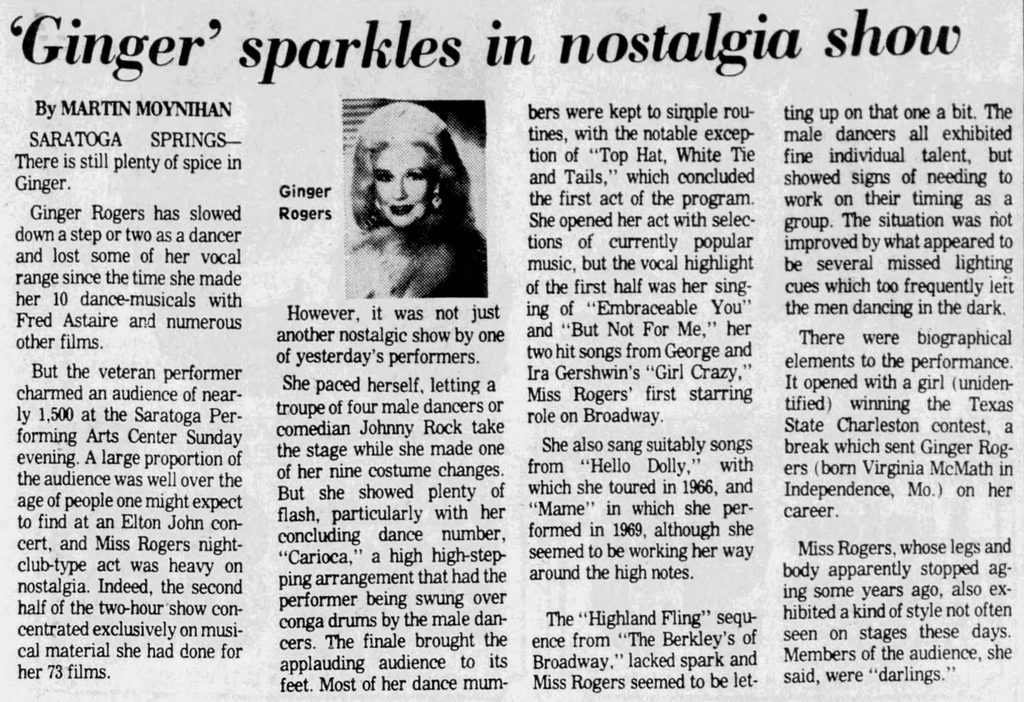
There is still plenty of spice in Ginger.
Ginger Rogers has slowed down a step or two as a dancer and lost some of her vocal range since the time she made her 10 dance-musicals with Fred Astaire and numerous other films.
But the veteran performer charmed an audience of nearly 1,500 at the Saratoga Performing Arts Center Sunday evening. A large proportion of the audience was well over the age of people one might expect to find at an Elton John concert, and Miss Rogers’ nightclub-type act was heavy on nostalgia. Indeed, the second half of the two-hour show concentrated exclusively on musical material she had done for her 73 films.
However, it was not just another nostalgic show by one of yesterday’s performers.
She paced herself, letting a troupe of four male dancers or comedian Johnny Dark take the stage while she made one of her nine costume changes. But she showed plenty of flash, particularly with her concluding dance number, “Carioca,” a high high-stepping arrangement that had the performer being swung over conga drums by the male dancers. The finale brought the applauding audience to its feet. Most of her dance numbers were kept to simple routines, with the notable exception of “Top Hat, White Tie and Tails,” which concluded the first act of the program.
She opened her act with selections of currently popular music, but the vocal highlight of the first half was her singing of “Embraceable You” and “But Not For Me,” her two hit songs from George and Ira Gershwin’s “Girl Crazy,” Miss Rogers’ first starring role on Broadway.
She also sang suitably songs from “Hello Dolly,” with which she toured in 1966, and “Mame” in which she performed in 1969, although she seemed to be working her way around the high notes.
The “Highland Fling” sequence from “The Berkley’s of Broadway” lacked spark, and Miss Rogers seemed to be letting up on that one a bit. The male dancers all exhibited fine individual talent, but showed signs of needing to work on their timing as a group. The situation was not improved by what appeared to be several missed lighting cues which too frequently left the men dancing in the dark.
There were biographical elements to the performance. It opened with a girl (unidentified) winning the Texas State Charleston contest, a break which sent Ginger Rogers (born Virginia McMath in Independence, Mo.) on her career.
Miss Rogers, whose legs and body apparently stopped aging some years ago, also exhibited a kind of style not often seen on stages these days. Members of the audience, she said, were “darlings.”
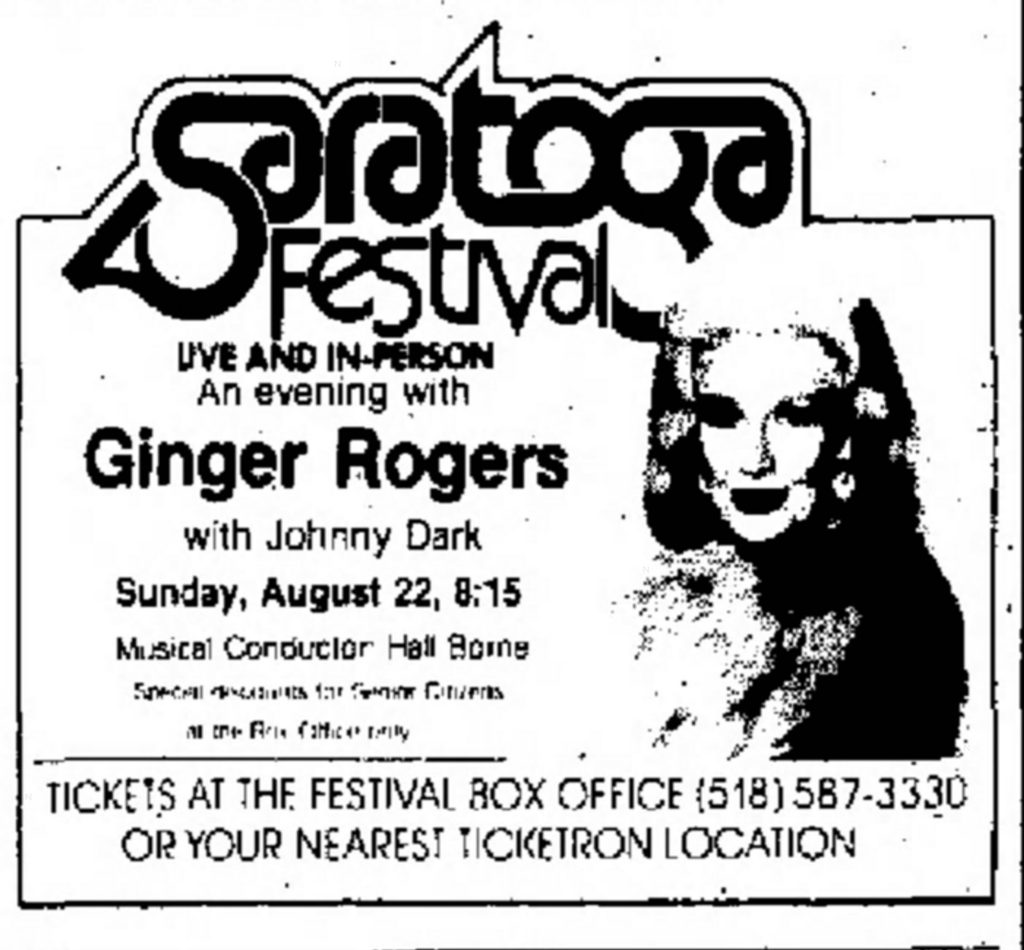
The Troy Record, August 22, 1976
Recent Comments