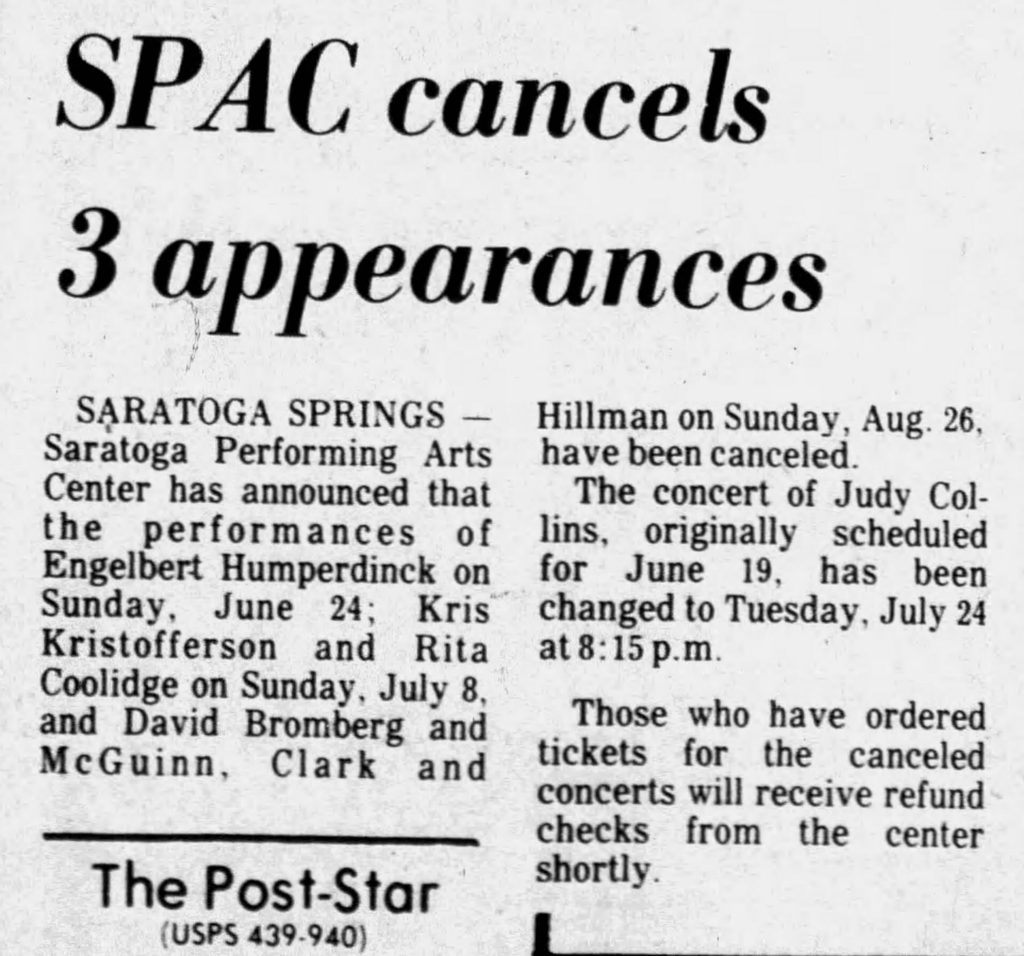
(editor’s note – Judy Collins was originally scheduled for this date, but moved to July 24)
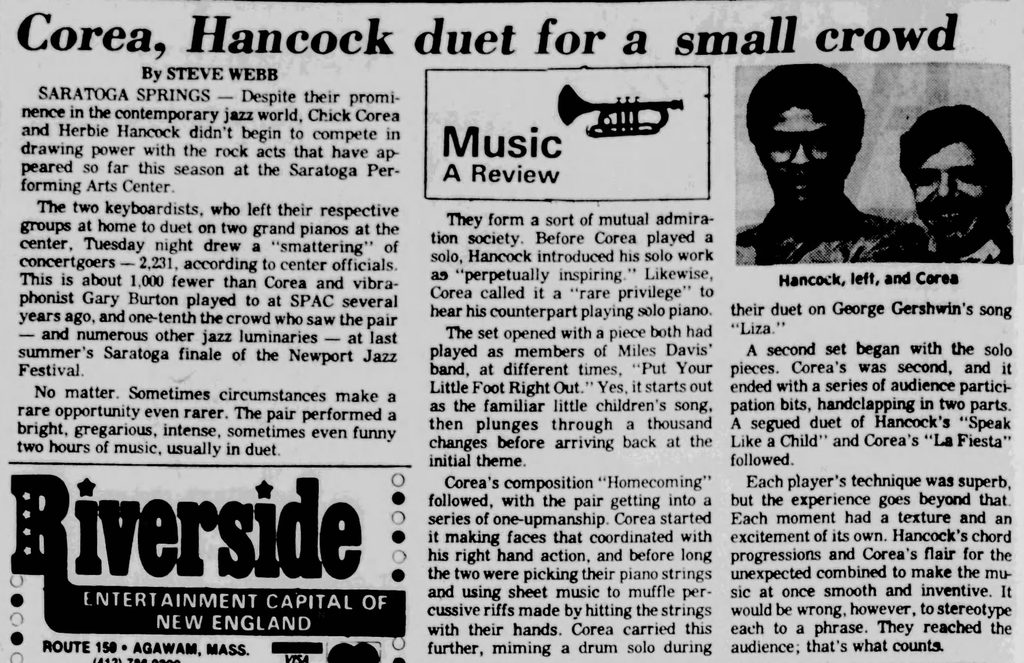
Corea, Hancock duet for a small crowd
by Steve Webb, The Knickerbocker News, June 20, 1979
Despite their prominence in the contemporary jazz world, Chick Corea and Herbie Hancock didn’t begin to compete in drawing power with the rock acts that have appeared so far this season at the Saratoga Performing Arts Center.
The two keyboardists, who left their respective groups at home to duet on two grand pianos at the center, Tuesday night drew a “smattering” of concertgoers – 2,231, according to center officials. This is about 1,000 fewer than Corea and vibraphonist Gary Burton played to at SPAC several years ago, and one-tenth the crowd who saw the pair — and numerous other jazz luminaries – at last summer’s Saratoga finale of the Newport Jazz Festival.
No matter. Sometimes circumstances make a rare opportunity even rarer. The pair performed a bright, gregarious, intense, sometimes even funny two hours of music, usually in duet.
They form a sort of mutual admiration society. Before Corea played a solo, Hancock introduced his solo work as “perpetually inspiring.” Likewise, Corea called it a “rare privilege” to hear his counterpart playing solo piano.
The set opened with a piece both had played as members of Miles Davis’ band, at different times, “Put Your Little Foot Right Out.” Yes, it starts out as the familiar little children’s song, then plunges through a thousand changes before arriving back at the initial theme.
Corea’s composition “Homecoming” followed, with the pair getting into a series of one-upmanship. Corea started it, making faces that coordinated with his right-hand action, and before long the two were picking their piano strings and using sheet music to muffle percussive riffs made by hitting the strings with their hands. Corea carried this further, miming a drum solo during their duet on George Gershwin’s song “Liza.”
A second set began with the solo pieces. Corea’s was second, and it ended with a series of audience participation bits, handclapping in two parts. A segued duet of Hancock’s “Speak Like a Child” and Corea’s “La Fiesta” followed.
Each player’s technique was superb, but the experience goes beyond that. Each moment had a texture and an excitement of its own. Hancock’s chord progressions and Corea’s flair for the unexpected combined to make the music at once smooth and inventive. It would be wrong, however, to stereotype each to a phrase. They reached the audience; that’s what counts.
The Post-Star, April 28, 1979
Recent Comments