Once it got started, Allman band stopped for nothing
by Steve Webb, The Knickerbocker News, June 12, 1979
In many ways it didn’t seem like it is nearly summer at all. It rained almost until concert time. It was cold all evening.
And the Allman Brothers Band seemed intent on putting off its kickoff concert at the Saratoga Performing Arts Center Monday night. The band didn’t even show up until shortly after 9 p.m., a full hour after Bob Welch’s opening set concluded.
That’s an arrogant gesture, if ever there was one. But once the band started playing, ooh, it was unbelievable. The group played just short of 2 1/2 hours of its inimitable brand of blues-jazz-country rock, easily reclaiming its spot as the vanguard of 1970s performing units and the top of the Deep South rock heap.
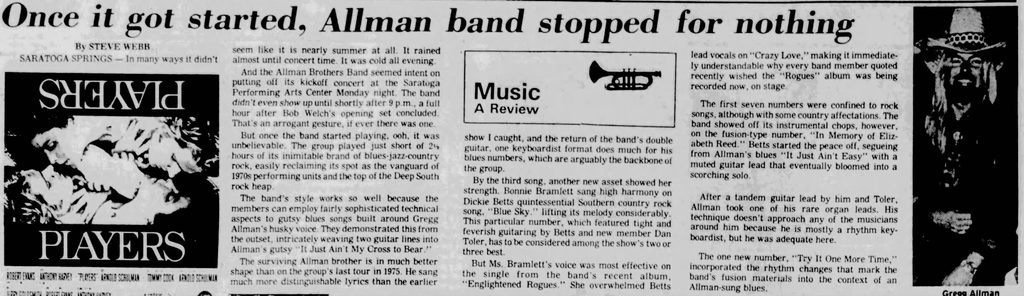
The band’s style works so well because the members can employ fairly sophisticated technical aspects to gutsy blues songs built around Gregg Allman’s husky voice. They demonstrated this from the outset, intricately weaving two guitar lines into Allman’s gutsy “It Just Ain’t My Cross to Bear.”
The surviving Allman brother is in much better shape than on the group’s last tour in 1975. He sang much more distinguishable lyrics than the earlier show I caught, and the return of the band’s double-guitar, one-keyboardist format does much for his blues numbers, which are arguably the backbone of the group.
By the third song, another new asset showed her strength. Bonnie Bramlett sang high harmony on Dickey Betts’ quintessential Southern country rock song, “Blue Sky,” lifting its melody considerably. This particular number, which featured tight and feverish guitaring by Betts and new member Dan Toler, has to be considered among the show’s two or three best.
But Ms. Bramlett’s voice was most effective on the single from the band’s recent album, “Enlightened Rogues.” She overwhelmed Betts lead vocals on “Crazy Love,” making it immediately understandable why every band member quoted recently wished the “Rogues” album was being recorded now, on stage.
The first seven numbers were confined to rock songs, although with some country affectations. The band showed off its instrumental chops, however, on the fusion-type number, “In Memory of Elizabeth Reed.” Betts started the piece off, segueing from Allman’s blues “It Just Ain’t Easy” with a muted guitar lead that eventually bloomed into a scorching solo.
After a tandem guitar lead by him and Toler, Allman took one of his rare organ leads. His technique doesn’t approach any of the musicians around him because he is mostly a rhythm keyboardist, but he was adequate here.
The one new number, “Try It One More Time,” incorporated the rhythm changes that mark the band’s fusion material into the context of an Allman-sung blues.
Recent Comments