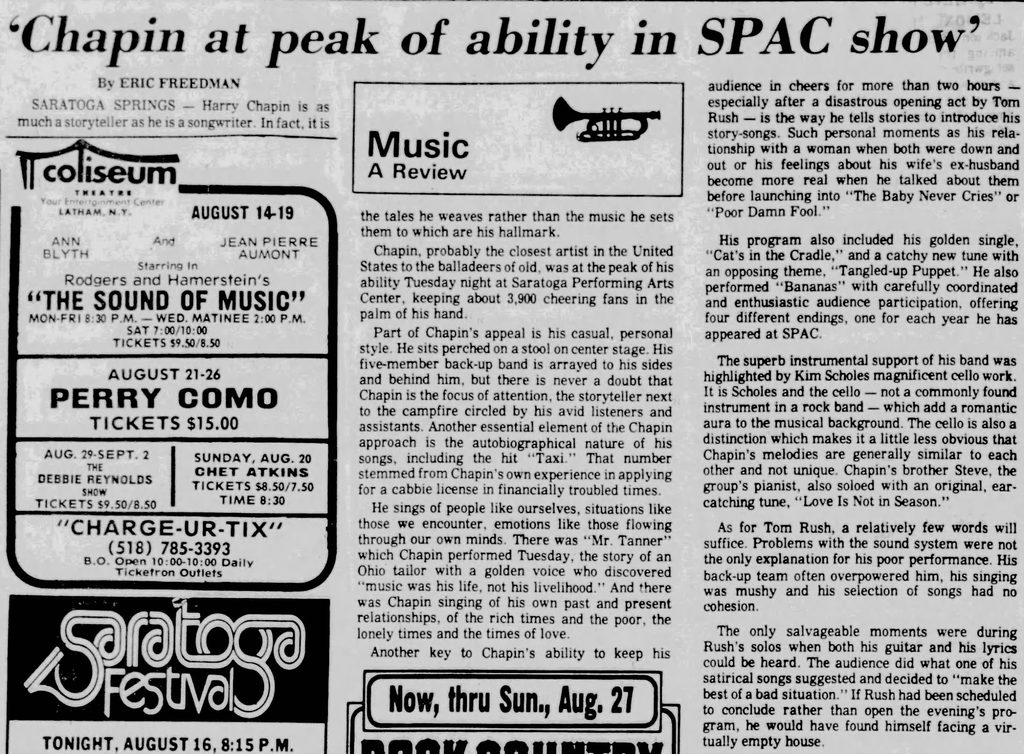
‘Chapin at peak of ability in SPAC show’
by Eric Freedman, The Knickerbocker News, August 31, 1978
Harry Chapin is as much a storyteller as he is a songwriter. In fact, it is the tales he weaves rather than the music he sets them to which are his hallmark.
Chapin, probably the closest artist in the United States to the balladeers of old, was at the peak of his ability Tuesday night at Saratoga Performing Arts Center, keeping about 3,900 cheering fans in the palm of his hand.
Part of Chapin’s appeal is his casual, personal style. He sits perched on a stool on center stage. His five-member back-up band is arrayed to his sides and behind him, but there is never a doubt that Chapin is the focus of attention, the storyteller next to the campfire circled by his avid listeners and assistants. Another essential element of the Chapin approach is the autobiographical nature of his songs, including the hit “Taxi.” That number stemmed from Chapin’s own experience in applying for a cabbie license in financially troubled times.
He sings of people like ourselves, situations like those we encounter, emotions like those flowing through our own minds. There was “Mr. Tanner,” which Chapin performed Tuesday, the story of an Ohio tailor with a golden voice who discovered “music was his life, not his livelihood.” And there was Chapin singing of his own past and present relationships, of the rich times and the poor, the lonely times and the times of love.
Another key to Chapin’s ability to keep his audience in cheers for more than two hours — especially after a disastrous opening act by Tom Rush — is the way he tells stories to introduce his story-songs. Such personal moments as his relationship with a woman when both were down and out, or his feelings about his wife’s ex-husband become more real when he talked about them before launching into “The Baby Never Cries” or “Poor Damn Fool.”\
His program also included his golden single, “Cat’s in the Cradle,” and a catchy new tune with an opposing theme, “Tangled-up Puppet.” He also performed “Bananas” with carefully coordinated and enthusiastic audience participation, offering four different endings, one for each year he has appeared at SPAC.
The superb instrumental support of his band was highlighted by Kim Scholes’ magnificent cello work. It is Scholes and the cello – not a commonly found instrument in a rock band – which add a romantic aura to the musical background. The cello is also a distinction which makes it a little less obvious that Chapin’s melodies are generally similar to each other and not unique. Chapin’s brother Steve, the group’s pianist, also soloed with an original, ear-catching tune, “Love Is Not in Season.”
As for Tom Rush, a relatively few words will suffice. Problems with the sound system were not the only explanation for his poor performance. His backup team often overpowered him, his singing was mushy, and his selection of songs had no cohesion.
The only salvageable moments were during Rush’s solos when both his guitar and his lyrics could be heard. The audience did what one of his satirical songs suggested and decided to “make the best of a bad situation.” If Rush had been scheduled to conclude rather than open the evening’s program, he would have found himself facing a virtually empty house.
Recent Comments