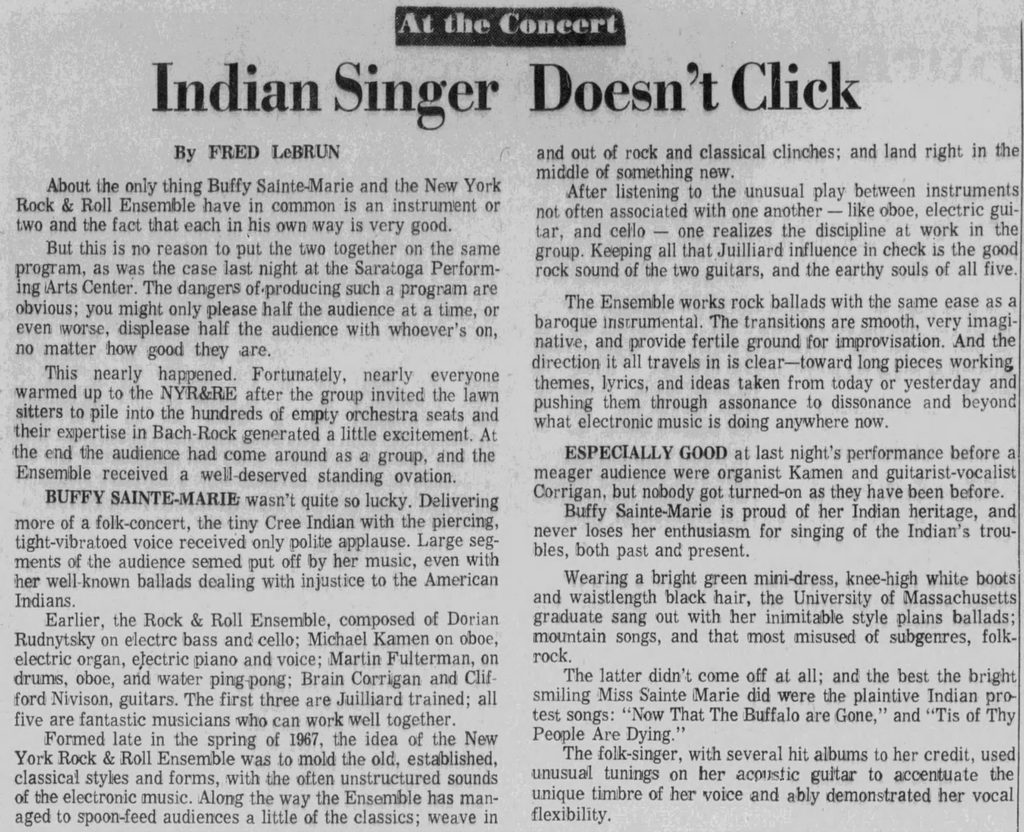
Indian Singer Doesn’t Click
by Fred LeBrun, The Knickerbocker News, July 22, 1969
About the only thing Buffy Sainte-Marie and the New York Rock & Roll Ensemble have in common is an instrument or two and the fact that each in his own way is very good.
But this is no reason to put the two together on the same program, as was the case last night at the Saratoga Performing Arts Center. The dangers of producing such a program are obvious; you might only please half the audience at a time, or even worse, displease half the audience with whoever’s on, no matter how good they are.
This nearly happened. Fortunately, nearly everyone warmed up to the NYR&RE after the group invited the lawn sitters to pile into the hundreds of empty orchestra seats and their expertise in Bach-Rock generated a little excitement. At the end, the audience had come around as a group, and the Ensemble received a well-deserved standing ovation.
BUFFY SAINTE-MARIE wasn’t quite so lucky. Delivering more of a folk-concert, the tiny Cree Indian with the piercing, tight-vibratoed voice received only polite applause. Large segments of the audience seemed put off by her music, even with her well-known ballads dealing with injustice to the American Indians.
Earlier, the Rock & Roll Ensemble, composed of Dorian Rudnytsky on electric bass and cello; Michael Kamen on oboe, electric organ, electric piano and voice; Martin Fulterman, on drums, oboe, and water ping-pong; Brian Corrigan and Clifford Nivison, guitars. The first three are Juilliard-trained; all five are fantastic musicians who can work well together.
Formed late in the spring of 1967, the idea of the New York Rock & Roll Ensemble was to mold the old, established, classical styles and forms with the often unstructured sounds of the electronic music. Along the way, the Ensemble has managed to spoon-feed audiences a little of the classics; weave in and out of rock and classical clinches; and land right in the middle of something new.
After listening to the unusual play between instruments not often associated with one another — like oboe, electric guitar, and cello — one realizes the discipline at work in the group. Keeping all that Juilliard influence in check is the good rock sound of the two guitars, and the earthy souls of all five.
The Ensemble works rock ballads with the same ease as a baroque instrumental. The transitions are smooth, very imaginative, and provide fertile ground for improvisation. And the direction it all travels in is clear—toward long pieces working themes, lyrics, and ideas taken from today or yesterday and pushing them through assonance to dissonance and beyond what electronic music is doing anywhere now.
ESPECIALLY GOOD at last night’s performance before a meager audience were organist Kamen and guitarist-vocalist Corrigan, but nobody got turned on as they have been before.
Buffy Sainte-Marie is proud of her Indian heritage, and never loses her enthusiasm for singing of the Indian’s troubles, both past and present.
Wearing a bright green mini-dress, knee-high white boots and waist-length black hair, the University of Massachusetts graduate sang out with her inimitable style plains ballads; mountain songs, and that most misused of subgenres, folk-rock.
The latter didn’t come off at all; and the best the bright smiling Miss Sainte Marie did were the plaintive Indian protest songs: “Now That The Buffalo are Gone,” and “Tis of Thy People Are Dying.”
The folk-singer, with several hit albums to her credit, used unusual tunings on her acoustic guitar to accentuate the unique timbre of her voice and ably demonstrated her vocal flexibility.
Recent Comments