Spa ‘Newport’ triumph for pure jazz
by Steve Webb, The Knickerbocker News, July 7, 1980
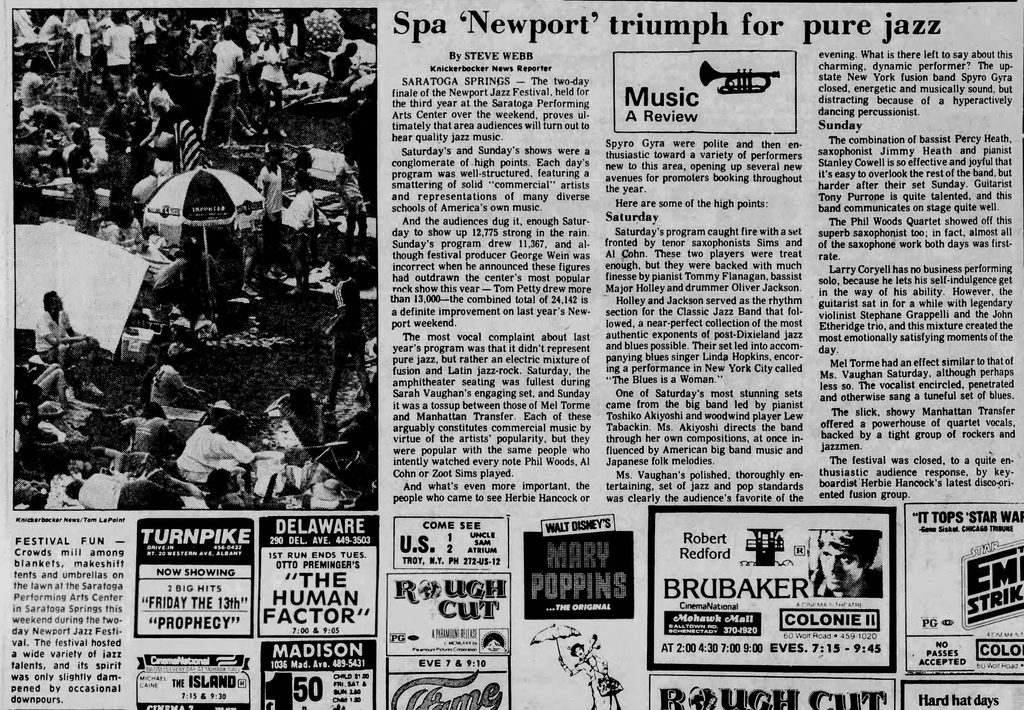
The two-day finale of the Newport Jazz Festival, held for the third year at the Saratoga Performing Arts Center over the weekend, proves ultimately that area audiences will turn out to hear quality jazz music.
Saturday’s and Sunday’s shows were a conglomerate of high points. Each day’s program was well-structured, featuring a smattering of solid “commercial” artists and representations of many diverse schools of America’s own music.
And the audiences dug it, enough Saturday to show up 12,775 strong in the rain. Sunday’s program drew 11,367, and although festival producer George Wein was incorrect when he announced these figures had outdrawn the center’s most popular rock show this year — Tom Petty drew more than 13,000 — the combined total of 24,142 is a definite improvement on last year’s Newport weekend.
The most vocal complaint about last year’s program was that it didn’t represent pure jazz, but rather an electric mixture of fusion and Latin jazz-rock. Saturday, the amphitheater seating was fullest during Sarah Vaughan’s engaging set, and Sunday it was a toss-up between those of Mel Torme and Manhattan Transfer. Each of these arguably constitutes commercial music by virtue of the artists’ popularity, but they were popular with the same people who intently watched every note Phil Woods, Al Cohn, or Zoot Sims played.
And what’s even more important, the people who came to see Herbie Hancock or Spyro Gyra were polite and then enthusiastic toward a variety of performers new to this area, opening up several new avenues for promoters booking throughout the year.
Here are some of the high points:
Saturday
Saturday’s program caught fire with a set fronted by tenor saxophonists Sims and Al Cohn. These two players were treat enough, but they were backed with much finesse by pianist Tommy Flanagan, bassist Major Holley and drummer Oliver Jackson.
Holley and Jackson served as the rhythm section for the Classic Jazz Band that followed, a near-perfect collection of the most authentic exponents of post-Dixieland jazz and blues possible. Their set led into accompanying blues singer Linda Hopkins, encoring a performance in New York City called “The Blues is a Woman.”
One of Saturday’s most stunning sets came from the big band led by pianist Toshiko Akiyoshi and woodwind player Lew Tabackin. Ms. Akiyoshi directs the band through her own compositions, at once influenced by American big band music and Japanese folk melodies.
Ms. Vaughan’s polished, thoroughly entertaining, set of jazz and pop standards was clearly the audience’s favorite of the evening. What is there left to say about this charming, dynamic performer? The upstate New York fusion band Spyro Gyra closed, energetic and musically sound, but distracting because of a hyperactively dancing percussionist.
Sunday
The combination of bassist Percy Heath, saxophonist Jimmy Heath and pianist Stanley Cowell is so effective and joyful that it’s easy to overlook the rest of the band, but harder after their set Sunday. Guitarist Tony Purrone is quite talented, and this band communicates on stage quite well.
The Phil Woods Quartet showed off this superb saxophonist too; in fact, almost all of the saxophone work both days was first-rate.
Larry Coryell has no business performing solo, because he lets his self-indulgence get in the way of his ability. However, the guitarist sat in for a while with legendary violinist Stephane Grappelli and the John Etheridge trio, and this mixture created the most emotionally satisfying moments of the day.
Mel Torme had an effect similar to that of Ms. Vaughan Saturday, although perhaps less so. The vocalist encircled, penetrated, and otherwise sang a tuneful set of blues.
The slick, showy Manhattan Transfer offered a powerhouse of quartet vocals, backed by a tight group of rockers and jazzmen.
The festival was closed, to a quite enthusiastic audience response, by keyboardist Herbie Hancock’s latest disco-oriented fusion group.
Recent Comments