Jackson Browne’s journey from art to entertainment, then back again
by Steve Webb, The Knickerbocker News, September 2, 1980
The song is “Stay,” Jackson Browne’s revised version of the 1961 hit by Maurice Williams and the Zodiacs, which Browne uses to end a song about rock shows called “The Load-Out.”
The Californian singer and songwriter had been singing while playing piano, but as the last instrumental section kicked up, he turned the keys over to organist Bill Payne and grabbed his electric guitar. Playing, he jumped and ran and signalled loose, rowdy solos by every band member before ending the encore selection.
For Browne to perform like this — a confident, flashy, even cocky abandon throughout the 2 1/2 hours of music — is quite a departure from his earlier, charming but self-involved stage presence.
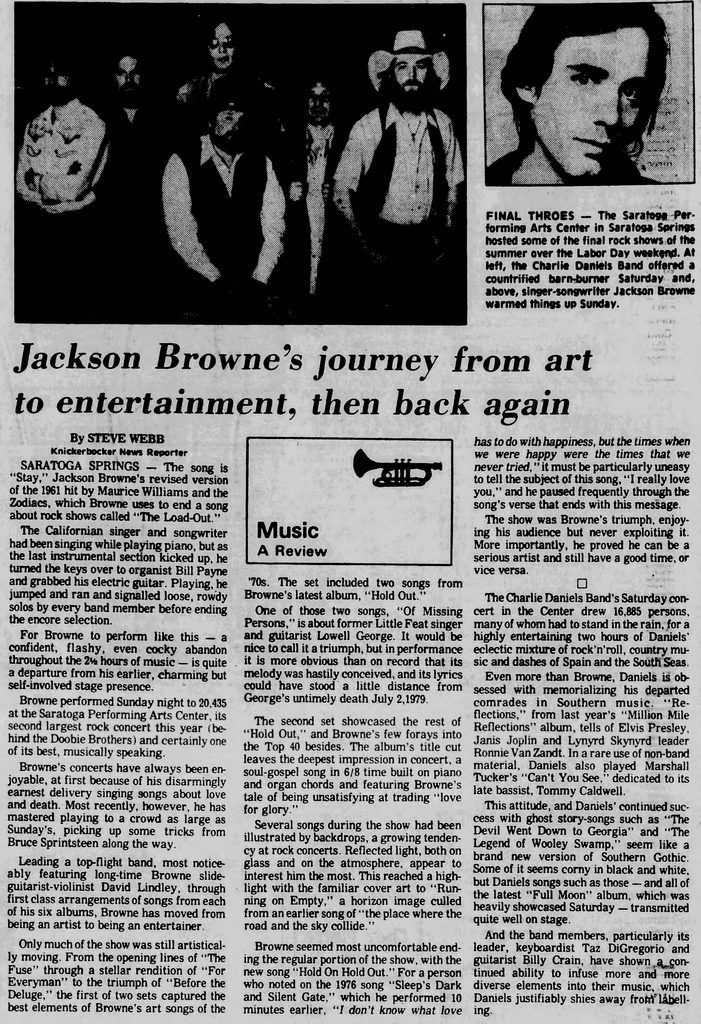
Browne performed Sunday night to 20,435 at the Saratoga Performing Arts Center, its second largest rock concert this year (behind the Doobie Brothers) and certainly one of its best, musically speaking.
Browne’s concerts have always been enjoyable, at first because of his disarmingly earnest delivery singing songs about love and death. Most recently, however, he has mastered playing to a crowd as large as Sunday’s, picking up some tricks from Bruce Springsteen along the way.
Leading a top-flight band, most noticeably featuring long-time Browne slide-guitarist-violinist David Lindley, through first-class arrangements of songs from each of his six albums, Browne has moved from being an artist to being an entertainer.
Only much of the show was still artistically moving. From the opening lines of “The Fuse” through a stellar rendition of “For Everyman” to the triumph of “Before the Deluge,” the first of two sets captured the best elements of Browne’s art songs of the ’70s. The set included two songs from Browne’s latest album, “Hold Out.”
One of those two songs, “Of Missing Persons, ” is about former Little Feat singer and guitarist Lowell George. It would be nice to call it a triumph, but in performance it is more obvious than on record that its melody was hastily conceived, and its lyrics could have stood a little distance from George’s untimely death July 2, 1979.
The second set showcased the rest of “Hold Out,” and Browne’s few forays into the Top 40 besides. The album’s title cut leaves the deepest impression in concert, a soul-gospel song in 6/8 time built on piano and organ chords and featuring Browne’s tale of being unsatisfying at trading “love for glory.”
Several songs during the show had been illustrated by backdrops, a growing tendency at rock concerts. Reflected light, both on glass and on the atmosphere, appear to interest him the most. This reached a highlight with the familiar cover art to “Running on Empty,” a horizon image culled from an earlier song of “the place where the road and the sky collide.”
Browne seemed most uncomfortable ending the regular portion of the show, with the new song “Hold On Hold Out.” For a person who noted on the 1976 song “Sleep’s Dark and Silent Gate,” which he performed 10 minutes earlier, “I don’t know what love has to do with happiness, but the times when we were happy were the times that we never tried,” it must be particularly uneasy to tell the subject of this song, “I really love you,” and he paused frequently through the song’s verse that ends with this message.
The show was Browne’s triumph, enjoying his audience but never exploiting it. More importantly, he proved he can be a serious artist and still have a good time, or vice versa.
Recent Comments