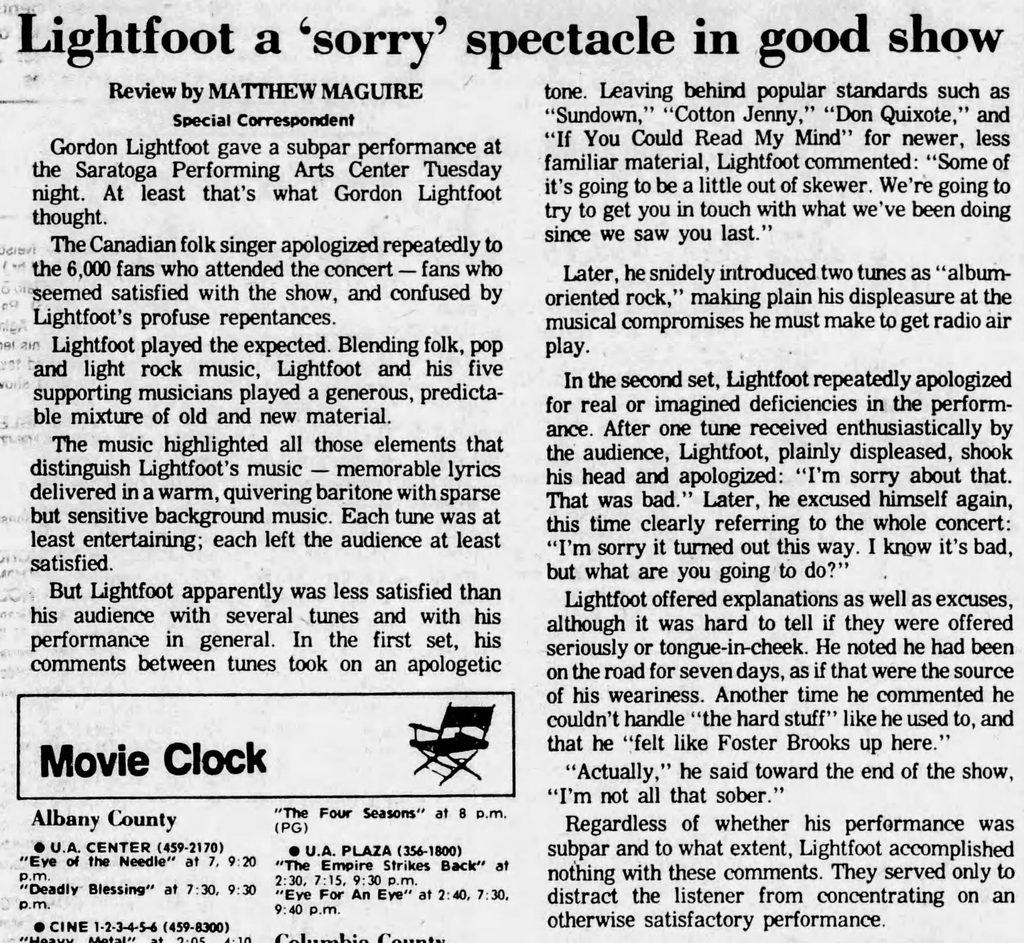
Lightfoot a ‘sorry’ spectacle in good show
by Matthew Maguire, The Knickerbocker News, August 19, 1981
Gordon Lightfoot gave a subpar performance at the Saratoga Performing Arts Center Tuesday night. At least that’s what Gordon Lightfoot thought.
The Canadian folk singer apologized repeatedly to the 6,000 fans who attended the concert — fans who seemed satisfied with the show, and confused by Lightfoot’s profuse repentances.
Lightfoot played the expected. Blending folk, pop and light rock music, Lightfoot and his five supporting musicians played a generous, predictable mixture of old and new material.
The music highlighted all those elements that distinguish Lightfoot’s music — memorable lyrics delivered in a warm, quivering baritone with sparse but sensitive background music. Each tune was at least entertaining; each left the audience at least satisfied.
But Lightfoot apparently was less satisfied than his audience with several tunes and with his performance in general. In the first set, his comments between tunes took on an apologetic tone. Leaving behind popular standards such as “Sundown,” “Cotton Jenny,” “Don Quixote,” and “If You Could Read My Mind” for newer, less familiar material, Lightfoot commented: “Some of it’s going to be a little out of skewer. We’re going to try to get you in touch with what we’ve been doing since we saw you last.”
Later, he snidely introduced two tunes as “album-oriented rock,” making plain his displeasure at the musical compromises he must make to get radio airplay.
In the second set, Lightfoot repeatedly apologized for real or imagined deficiencies in the performance. After one tune received enthusiastically by the audience, Lightfoot, plainly displeased, shook his head and apologized: “I’m sorry about that. That was bad.” Later, he excused himself again, this time clearly referring to the whole concert: “I’m sorry it turned out this way. I know it’s bad, but what are you going to do?”
Lightfoot offered explanations as well as excuses, although it was hard to tell if they were offered seriously or tongue-in-cheek. He noted he had been on the road for seven days, as if that were the source of his weariness. Another time he commented he couldn’t handle “the hard stuff” like he used to, and that he “felt like Foster Brooks up here.”
“Actually,” he said toward the end of the show, “I’m not all that sober.”
Regardless of whether his performance was subpar and to what extent, Lightfoot accomplished nothing with these comments. They served only to distract the listener from concentrating on an otherwise satisfactory performance.
Recent Comments