(editor’s note – no ex post facto proof for Johnny Van Zant)
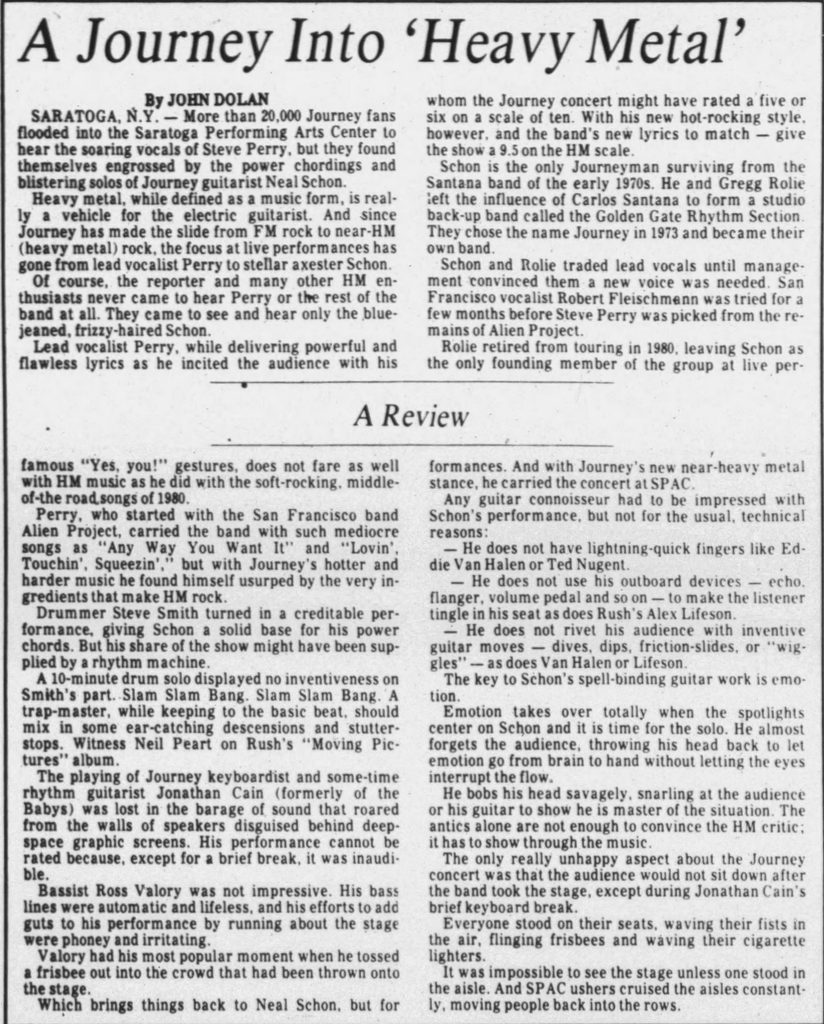
A Journey Into ‘Heavy Metal’
by John Dolan, Rutland Daily Herald, August 29, 1981
More than 20,000 Journey fans flooded into the Saratoga Performing Arts Center to hear the soaring vocals of Steve Perry, but they found themselves engrossed by the power chordings and blistering solos of Journey guitarist Neal Schon.
Heavy metal, while defined as a music form, is really a vehicle for the electric guitarist. And since Journey has made the slide from FM rock to near-HM (heavy metal) rock, the focus at live performances has gone from lead vocalist Perry to stellar axester Schon.
Of course, the reporter and many other HM enthusiasts never came to hear Perry or the rest of the band at all. They came to see and hear only the blue-jeaned, frizzy-haired Schon.
Lead vocalist Perry, while delivering powerful and flawless lyrics as he incited the audience with his famous “Yes, you!” gestures, does not fare as well with HM music as he did with the soft-rocking, middle-of-the-road songs of 1980.
Perry, who started with the San Francisco band Alien Project, carried the band with such mediocre songs as “Any Way You Want It” and “Lovin’, Touchin’, Squeezin’,” but with Journey’s hotter and harder music he found himself usurped by the very ingredients that make HM rock.
Drummer Steve Smith turned in a creditable performance, giving Schon a solid base for his power chords. But his share of the show might have been supplied by a rhythm machine.
A 10-minute drum solo displayed no inventiveness on Smith’s part. Slam Slam Bang. Slam Slam Bang. A trap-master, while keeping to the basic beat, should mix in some ear-catching descensions and stutter-stops. Witness Neil Peart on Rush’s “Moving Pictures” album.
The playing of Journey keyboardist and sometime rhythm guitarist Jonathan Cain (formerly of the Babys) was lost in the barrage of sound that roared from the walls of speakers disguised behind deep-space graphic screens. His performance cannot be rated because, except for a brief break, it was inaudible.
Bassist Ross Valory was not impressive. His bass lines were automatic and lifeless, and his efforts to add guts to his performance by running about the stage were phoney and irritating.
Valory had his most popular moment when he tossed a frisbee out into the crowd that had been thrown onto the stage.
Which brings things back to Neal Schon, but for whom the Journey concert might have rated a five or six on a scale of ten. With his new hot-rocking style, however, and the band’s new lyrics to match – give
the show a 9.5 on the HM scale.
Schon is the only Journeyman surviving from the Santana band of the early 1970s. He and Gregg Rolie left the influence of Carlos Santana to form a studio back-up band called the Golden Gate Rhythm Section. They chose the name Journey in 1973 and became their own band.
Schon and Rolie traded lead vocals until management convinced them a new voice was needed. San Francisco vocalist Robert Fleischman was tried for a few months before Steve Perry was picked from the remains of Alien Project.
Rolie retired from touring in 1980, leaving Schon as the only founding member of the group at live performances. And with Journey’s new near-heavy metal stance, he carried the concert at SPAC.
Any guitar connoisseur had to be impressed with Schon’s performance, but not for the usual, technical reasons:
— He does not have lightning-quick fingers like Eddie Van Halen or Ted Nugent.
— He does not use his outboard devices — echo, flanger, volume pedal and so on — to make the listener tingle in his seat as does Rush’s Alex Lifeson.
— He does not rivet his audience with inventive guitar moves — dives, dips, friction-slides, or “wiggles” — as does Van Halen or Lifeson.
The key to Schon’s spell-binding guitar work is emotion.
Emotion takes over totally when the spotlights center on Schon and it is time for the solo. He almost forgets the audience, throwing his head back to let emotion go from brain to hand without letting the eyes interrupt the flow.
He bobs his head savagely, snarling at the audience or his guitar to show he is master of the situation. The antics alone are not enough to convince the HM critic: it has to show through the music.
The only really unhappy aspect about the Journey concert was that the audience would not sit down after the band took the stage, except during Jonathan Cain’s brief keyboard break.
Everyone stood on their seats, waving their fists in the air, flinging frisbees and waving their cigarette lighters.
It was impossible to see the stage unless one stood in the aisle. And SPAC ushers cruised the aisles constantly, moving people back into the rows.
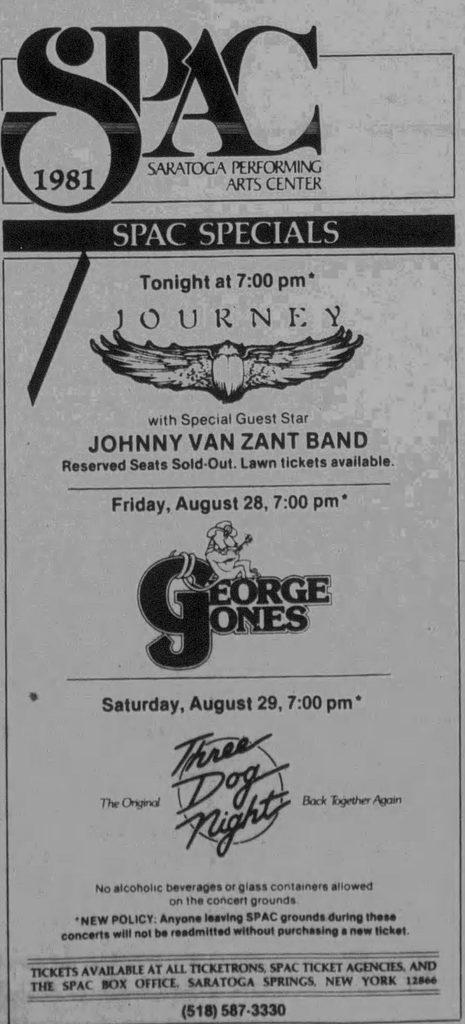
The Post-Star, August 27, 1981
Recent Comments