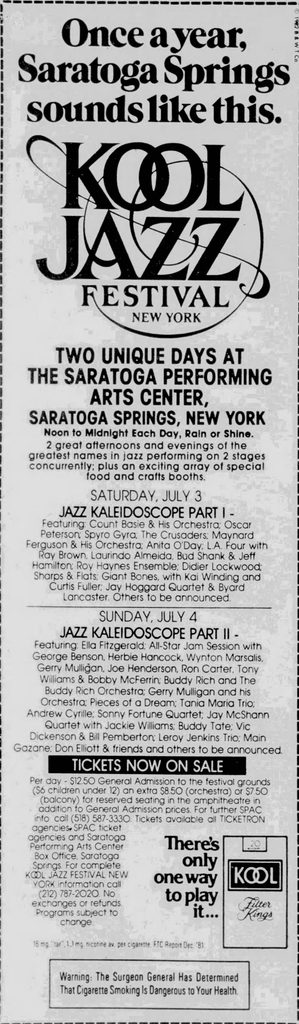
(editor’s note – no ex post facto proof for Herbie Hancock, Wynton Marsalis, Bobby McFerrin, Tania Maria, Sonny Fortune, Jay McShann, Jackie Williams, Buddy Tate, Vic Dickenson, Bill Pemberton, Leroy Jenkins, or Don Elliott)
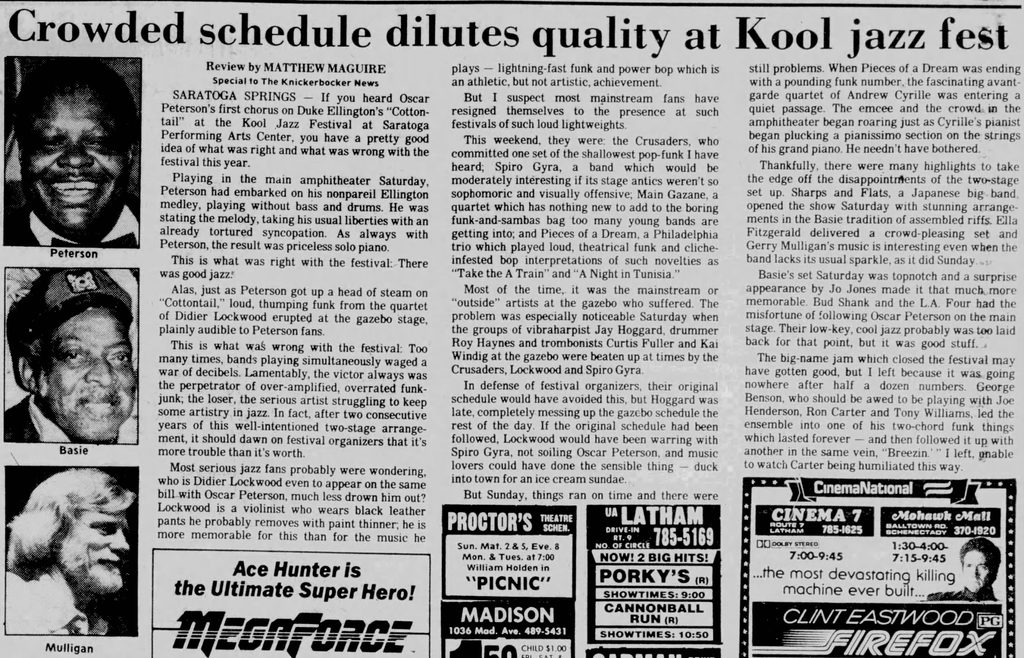
Crowded schedule dilutes quality at Kool jazz fest
by Matthew Maguire, The Knickerbocker News, July 6, 1982
If you heard Oscar Peterson’s first chorus on Duke Ellington’s “Cottontail” at the Kool Jazz Festival at Saratoga Performing Arts Center, you have a pretty good idea of what was right and what was wrong with the festival this year.
Playing in the main amphitheater Saturday, Peterson had embarked on his nonpareil Ellington medley, playing without bass and drums. He was stating the melody, taking his usual liberties with an already tortured syncopation. As always with Peterson, the result was priceless solo piano.
This is what was right with the festival: There was good jazz.
Alas, just as Peterson got up a head of steam on “Cottontail,” loud, thumping funk from the quartet of Didier Lockwood erupted at the gazebo stage, plainly audible to Peterson fans.
This is what was wrong with the festival: Too many times, bands playing simultaneously waged a war of decibels. Lamentably, the victor always was the perpetrator of over-amplified, overrated funk-junk; the loser, the serious artist struggling to keep some artistry in jazz. In fact, after two consecutive years of this well-intentioned two-stage arrangement, it should dawn on festival organizers that it’s more trouble than it’s worth.
Most serious jazz fans probably were wondering, who is Didier Lockwood even to appear on the same bill with Oscar Peterson, much less drown him out? Lockwood is a violinist who wears black leather pants he probably removes with paint thinner; he is more memorable for this than for the music he plays — lightning-fast funk and power bop, which is an athletic, but not artistic, achievement.
But I suspect most mainstream fans have resigned themselves to the presence at such festivals of such loud lightweights.
This weekend, they were the Crusaders, who committed one set of the shallowest pop-funk I have heard; Spyro Gyra, a band which would be moderately interesting if its stage antics weren’t so sophomoric and visually offensive; Main Gazane, a quartet which has nothing new to add to the boring funk-and-sambas bag too many young bands are getting into; and Pieces of a Dream, a Philadelphia trio which played loud, theatrical funk and cliché-infested bop interpretations of such novelties as “Take the A Train” and “A Night in Tunisia.”
Most of the time, it was the mainstream or “outside” artists at the gazebo who suffered. The problem was especially noticeable Saturday when the groups of vibraharpist Jay Hoggard, drummer Roy Haynes and trombonists Curtis Fuller and Kai Winding at the gazebo were beaten up at times by the Crusaders, Lockwood and Spyro Gyra.
In defense of festival organizers, their original schedule would have avoided this, but Hoggard was late, completely messing up the gazebo schedule the rest of the day. If the original schedule had been followed, Lockwood would have been warring with Spyro Gyra, not soiling Oscar Peterson, and music lovers could have done the sensible thing — duck into town for an ice cream sundae.
But Sunday, things ran on time, and there were still problems. When Pieces of a Dream was ending with a pounding funk number, the fascinating avant-garde quartet of Andrew Cyrille was entering a quiet passage. The emcee and the crowd in the amphitheater began roaring just as Cyrille’s pianist began plucking a pianissimo section on the strings of his grand piano. He needn’t have bothered.
Thankfully, there were many highlights to take the edge off the disappointments of the two-stage setup. Sharps and Flats, a Japanese big band, opened the show Saturday with stunning arrangements in the Basie tradition of assembled riffs. Ella Fitzgerald delivered a crowd-pleasing set, and Gerry Mulligan’s music is interesting even when the band lacks its usual sparkle, as it did Sunday.
Basie’s set Saturday was top-notch, and a surprise appearance by Jo Jones made it that much more memorable. Bud Shank and the L.A. Four had the misfortune of following Oscar Peterson on the main stage. Their low-key, cool jazz probably was too laid back for that point, but it was good stuff.
The big-name jam which closed the festival may have gotten good, but I left because it was going nowhere after half a dozen numbers. George Benson, who should be awed to be playing with Joe Henderson, Ron Carter and Tony Williams, led the ensemble into one of his two-chord funk things which lasted forever — and then followed it up with another in the same vein, “Breezin’.” I left, unable to watch Carter being humiliated this way.
The Knickerbocker News, July 2, 1982
Recent Comments