Elton John back at SPAC: Tight show and top crowd
by Bruce Whitney, North Adams Transcript, July 27, 1982
An Englishman named Reginald Dwight drew a record-to-date 1982 crowd and rebutted many recent articles and press releases characterizing him as being a little more low-key.
What actually happened Sunday night was that 25,300 people at Saratoga Performing Arts Center (SPAC) witnessed a two-hour-plus performance from the tireless recorder and still flamboyant performer Elton John. And Captain Fantastic was hot.
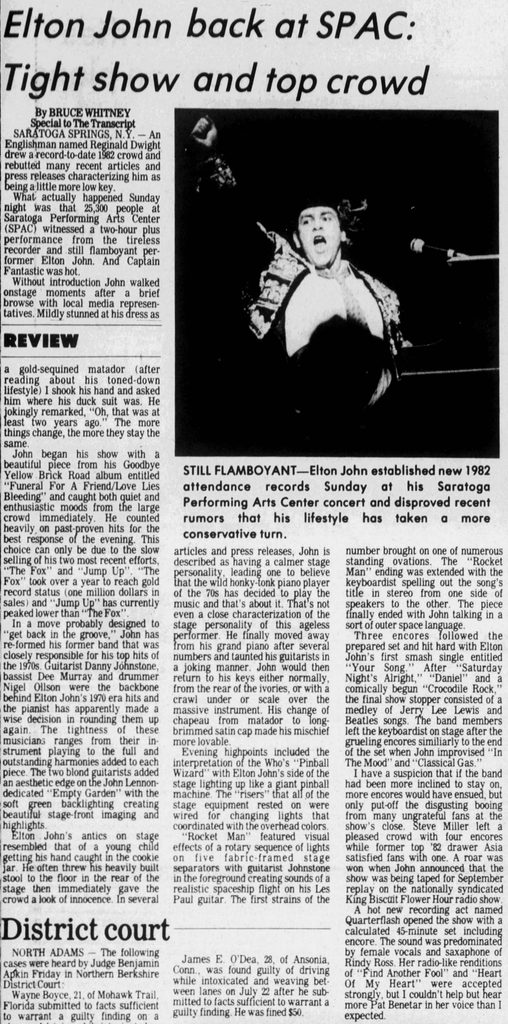
Without introduction, John walked onstage moments after a brief browse with local media representatives. Mildly stunned at his dress as a gold-sequined matador (after reading about his toned-down lifestyle), I shook his hand and asked him where his duck suit was. He jokingly remarked, “Oh, that was at least two years ago.” The more things change, the more they stay the same.
John began his show with a beautiful piece from his Goodbye Yellow Brick Road album entitled “Funeral For A Friend/Love Lies Bleeding” and caught both quiet and enthusiastic moods from the large crowd immediately. He counted heavily on past-proven hits for the best response of the evening. This choice can only be due to the slow selling of his two most recent efforts, “The Fox” and “Jump Up”. “The Fox” took over a year to reach gold record status (one million dollars in sales) and “Jump Up” has currently peaked lower than “The Fox.”
In a move probably designed to “get back in the groove,” John has re-formed his former band that was closely responsible for his top hits of the 1970s. Guitarist Danny Johnstone, bassist Dee Murray, and drummer Nigel Olsson were the backbone behind Elton John’s 1970 era hits, and the pianist has apparently made a wise decision in rounding them up again. The tightness of these musicians ranges from their instrument playing to the full and outstanding harmonies added to each piece. The two blond guitarists added an aesthetic edge on the John Lennon-dedicated “Empty Garden,” with the soft green backlighting creating beautiful stage front imaging and highlights.
Elton John’s antics on stage resembled that of a young child getting his hand caught in the cookie jar. He often threw his heavily built stool to the floor in the rear of the stage, then immediately gave the crowd a look of innocence. In several articles and press releases, John is described as having a calmer stage personality, leading one to believe that the wild honky-tonk piano player of the 70s has decided to play the music and that’s about it. That’s not even a close characterization of the stage personality of this ageless performer. He finally moved away from his grand piano after several numbers and taunted his guitarists in a joking manner. John would then return to his keys either normally, from the rear of the ivories, or with a crawl under or scale over the massive instrument. His change of chapeau from matador to long-brimmed satin cap made his mischief more lovable.
Evening highpoints included the interpretation of the Who’s “Pinball Wizard” with Elton John’s side of the stage lighting up like a giant pinball machine. The “risers” that all of the stage equipment rested on were wired for changing lights that coordinated with the overhead colors.
“Rocket Man” featured visual effects of a rotary sequence of lights on five fabric-framed stage separators, with guitarist Johnstone in the foreground creating sounds of a realistic spaceship flight on his Les Paul guitar. The first strains of the number brought on one of numerous standing ovations. The “Rocket Man” ending was extended with the keyboardist spelling out the song’s title in stereo from one side of speakers to the other. The piece finally ended with John talking in a sort of outer space language.
Three encores followed the prepared set and hit hard with Elton John’s first smash single entitled “Your Song.” After “Saturday Night’s Alright,” “Daniel” and a comically begun “Crocodile Rock,” the final showstopper consisted of a medley of Jerry Lee Lewis and Beatles songs. The band members left the keyboardist on stage after the grueling encores similiarly to the end of the set when John improvised “In The Mood” and “Classical Gas.”
I have a suspicion that if the band had been more inclined to stay on, more encores would have ensued, but only put off the disgusting booing from many ungrateful fans at the show’s close. Steve Miller left a pleased crowd with four encores while former top ’82 drawer Asia satisfied fans with one. A roar was won when John announced that the show was being taped for September replay on the nationally syndicated King Biscuit Flower Hour radio show.
A hot new recording act named Quarterflash opened the show with a calculated 45-minute set including encore. The sound was predominated by female vocals and saxophone of Rindy Ross. Her radio-like renditions of “Find Another Fool” and “Heart of My Heart” were accepted strongly, but I couldn’t help but hear more Pat Benatar in her voice than I expected.
Recent Comments