Deadheads, Beachheads hear timeless music
by Steve Webb, The Knickerbocker News, June 20, 1983
With the exception of a few songs, both weekend concerts at the Saratoga Performing Arts Center could have been performed in 1974, or 1969 for that matter.
Either the Grateful Dead and the Beach Boys are both living hopelessly in the past, playing ’60s and early 70s music to 80s audiences, or else the music has a timeless element that transcends decades.
Either way, the 31,587 who saw the Dead on Saturday and the approximately 7,900 who saw the Beach Boys on Sunday had good reason to feel satisfied. They all witnessed a vibrant, interesting, and entertaining show by two of America’s best rock bands.
The Dead opened its latest tour at SPAC, while the Beach Boys closed theirs. In both cases, that implies some raggedness that was evident in the shows, but also a certain spirit that made up for the raggedness. Each band’s stage had one lone non-instrument decoration — an American flag.
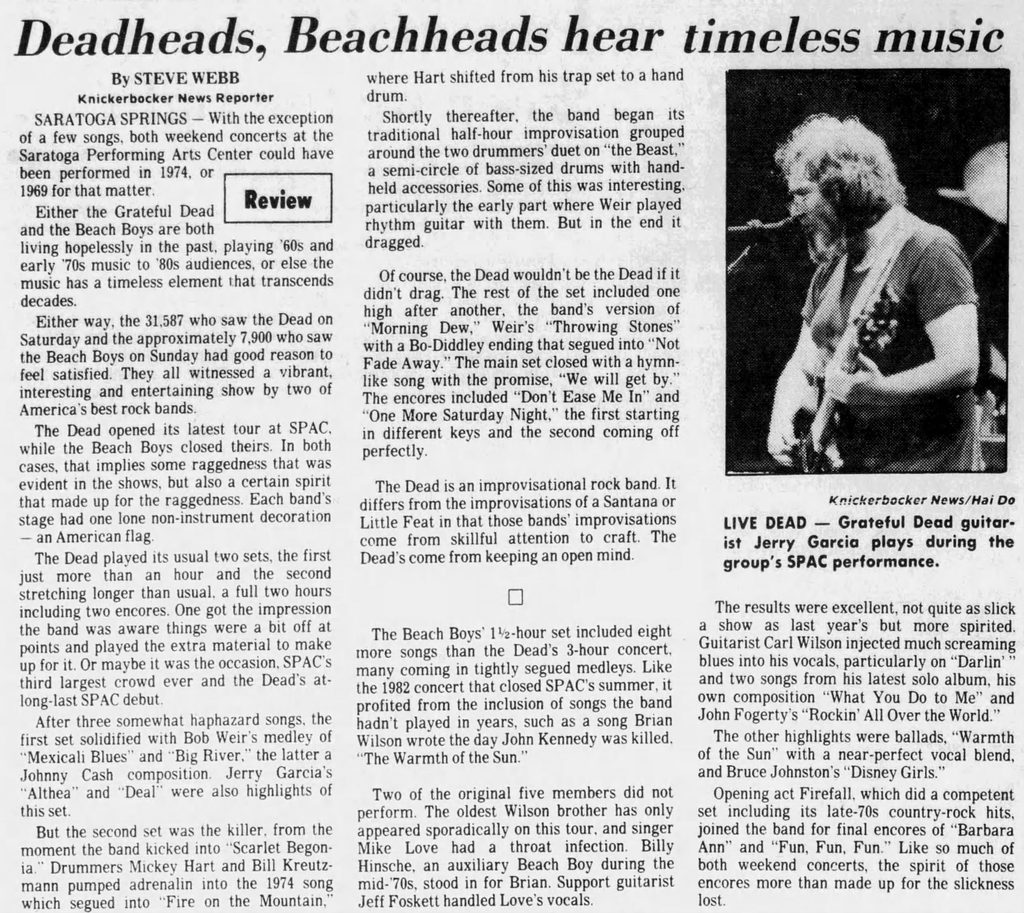
The Dead played its usual two sets, the first just more than an hour and the second stretching longer than usual, a full two hours including two encores. One got the impression the band was aware things were a bit off at points and played the extra material to make up for it. Or maybe it was the occasion, SPAC’s third largest crowd ever and the Dead’s at-long-last SPAC debut.
After three somewhat haphazard songs, the first set solidified with Bob Weir’s medley of “Mexicali Blues” and “Big River,” the latter a Johnny Cash composition. Jerry Garcia’s “Althea” and “Deal” were also highlights of this set.
But the second set was the killer, from the moment the band kicked into “Scarlet Begonia.” Drummers Mickey Hart and Bill Kreutzmann pumped adrenaline into the 1974 song, which segued into “Fire on the Mountain, where Hart shifted from his trap set to a hand drum.
Shortly thereafter, the band began its traditional half-hour improvisation grouped around the two drummers’ duet on “the Beast,” a semi-circle of bass-sized drums with handheld accessories. Some of this was interesting, particularly the early part where Weir played rhythm guitar with them. But in the end it dragged.
Of course, the Dead wouldn’t be the Dead if it didn’t drag. The rest of the set included one high after another, the band’s version of “Morning Dew,” Weir’s “Throwing Stones” with a Bo-Diddley ending that segued into “Not Fade Away.” The main set closed with a hymn-like song with the promise, “We will get by.” The encores included “Don’t Ease Me In” and “One More Saturday Night,” the first starting in different keys and the second coming off perfectly.
The Dead is an improvisational rock band. It differs from the improvisations of a Santana or Little Feat in that those bands’ improvisations come from skillful attention to craft. The Dead’s come from keeping an open mind.
Recent Comments