Ravi Shankar, Saratoga
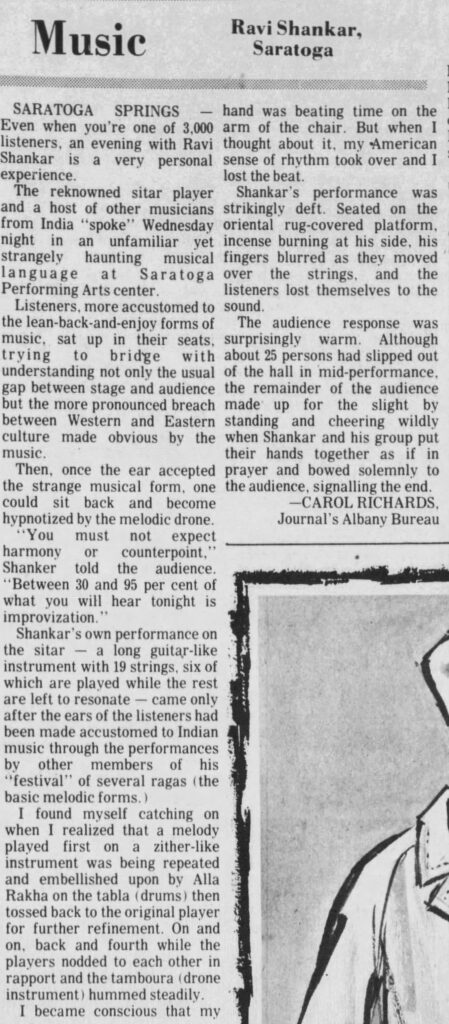
by Carol Richards, The Ithaca Journal, August 8, 1968
Even when you’re one of 3,000 listeners, an evening with Ravi Shankar is a very personal experience.
The renowned sitar player and a host of other musicians from India “spoke” Wednesday night in an unfamiliar yet strangely haunting musical language at Saratoga Performing Arts Center.
Listeners, more accustomed to the lean-back-and-enjoy forms of music, sat up in their seats, trying to bridge with understanding not only the usual gap between stage and audience but the more pronounced breach between Western and Eastern culture made obvious by the music.
Then, once the ear accepted the strange musical form, one could sit back and become hypnotized by the melodic drone.
“You must not expect harmony or counterpoint,” Shankar told the audience. “Between 30 and 95 percent of what you will hear tonight is improvisation.”
Shankar’s own performance on the sitar – a long guitar-like instrument with 19 strings, six of which are played while the rest are left to resonate – came only after the ears of the listeners had been made accustomed to Indian music through the performances by other members of his “festival” of several ragas (the basic melodic forms).
I found myself catching on when I realized that a melody played first on a zither-like instrument was being repeated and embellished upon by Alla Rakha on the tabla (drums) then tossed back to the original player for further refinement. On and on, back and forth while the players nodded to each other in rapport and the tamboura (drone instrument) hummed steadily.
I became conscious that my hand was beating time on the arm of the chair. But when I thought about it, my American sense of rhythm took over and I lost the beat.
Shankar’s performance was strikingly deft. Seated on the oriental rug-covered platform, incense burning at his side, his fingers blurred as they moved over the strings, and the listeners lost themselves to the sound.
The audience response was surprisingly warm. Although about 25 persons had slipped out of the hall in mid-performance, the remainder of the audience made up for the slight by standing and cheering wildly when Shankar and his group put their hands together as if in prayer and bowed solemnly to the audience, signalling the end
Recent Comments