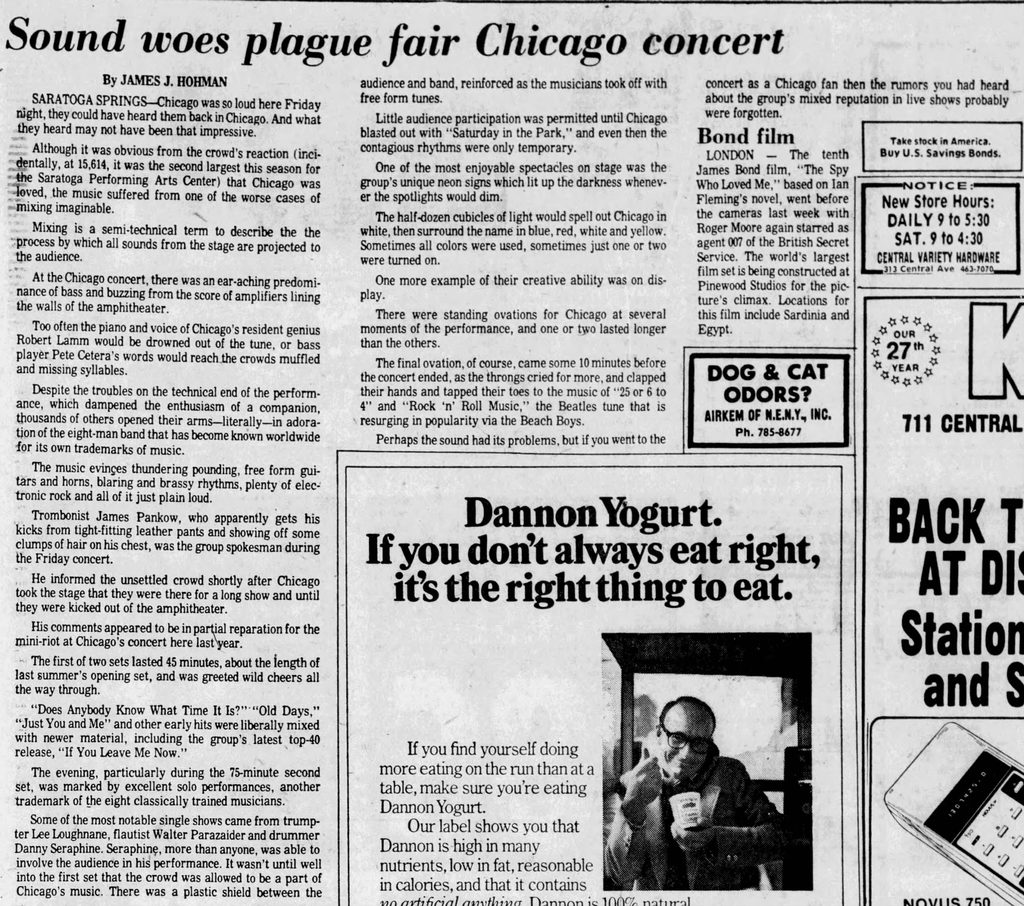
Sound woes plague fair Chicago concert
by James J. Hohman, The Knickerbocker News, September 7, 1976
Chicago was so loud here Friday night, they could have heard them back in Chicago. And what they heard may not have been that impressive.
Although it was obvious from the crowd’s reaction (incidentally, at 15,614, it was the second largest this season for the Saratoga Performing Arts Center) that Chicago was loved, the music suffered from one of the worst cases of mixing imaginable.
Mixing is a semi-technical term to describe the process by which all sounds from the stage are projected to the audience.
At the Chicago concert, there was an ear-aching predominance of bass and buzzing from the score of amplifiers lining the walls of the amphitheater.
Too often the piano and voice of Chicago’s resident genius Robert Lamm would be drowned out of the tune, or bass player Pete Cetera’s words would reach the crowds muffled and missing syllables.
Despite the troubles on the technical end of the performance, which dampened the enthusiasm of a companion, thousands of others opened their arms—literally—in adoration of the eight-man band that has become known worldwide for its own trademarks of music.
The music evinces thundering pounding, free-form guitars and horns, blaring and brassy rhythms, plenty of electronic rock and all of it just plain loud.
Trombonist James Pankow, who apparently gets his kicks from tight-fitting leather pants and showing off some clumps of hair on his chest, was the group spokesman during the Friday concert.
He informed the unsettled crowd shortly after Chicago took the stage that they were there for a long show and until they were kicked out of the amphitheater.
His comments appeared to be in partial reparation for the mini-riot at Chicago’s concert here last year.
The first of two sets lasted 45 minutes, about the length of last summer’s opening set, and was greeted with wild cheers all the way through.
“Does Anybody Know What Time It Is?” “Old Days,” “Just You and Me,” and other early hits were liberally mixed with newer material, including the group’s latest top-40 release, “If You Leave Me Now.”
The evening, particularly during the 75-minute second set, was marked by excellent solo performances, another trademark of the eight classically trained musicians.
Some of the most notable single shows came from trumpeter Lee Loughnane, flautist Walter Parazaider, and drummer Danny Seraphine. Seraphine, more than anyone, was able to involve the audience in his performance. It wasn’t until well into the first set that the crowd was allowed to be a part of Chicago’s music. There was a plastic shield between the audience and band, reinforced as the musicians took off with free-form tunes.
Little audience participation was permitted until Chicago blasted out with “Saturday in the Park,” and even then the contagious rhythms were only temporary.
One of the most enjoyable spectacles on stage was the group’s unique neon signs, which lit up the darkness whenever the spotlights would dim.
The half-dozen cubicles of light would spell out Chicago in white, then surround the name in blue, red, white and yellow.
Sometimes all colors were used, sometimes just one or two were turned on.
One more example of their creative ability was on display.
There were standing ovations for Chicago at several moments of the performance, and one or two lasted longer than the others.
The final ovation, of course, came some 10 minutes before the concert ended, as the throngs cried for more, and clapped their hands and tapped their toes to the music of “25 or 6 to 4” and “Rock ‘n’ Roll Music,” the Beatles tune that is resurging in popularity via the Beach Boys.
Perhaps the sound had its problems, but if you went to the concert as a Chicago fan, then the rumors you had heard about the group’s mixed reputation in live shows probably were forgotten.
Recent Comments