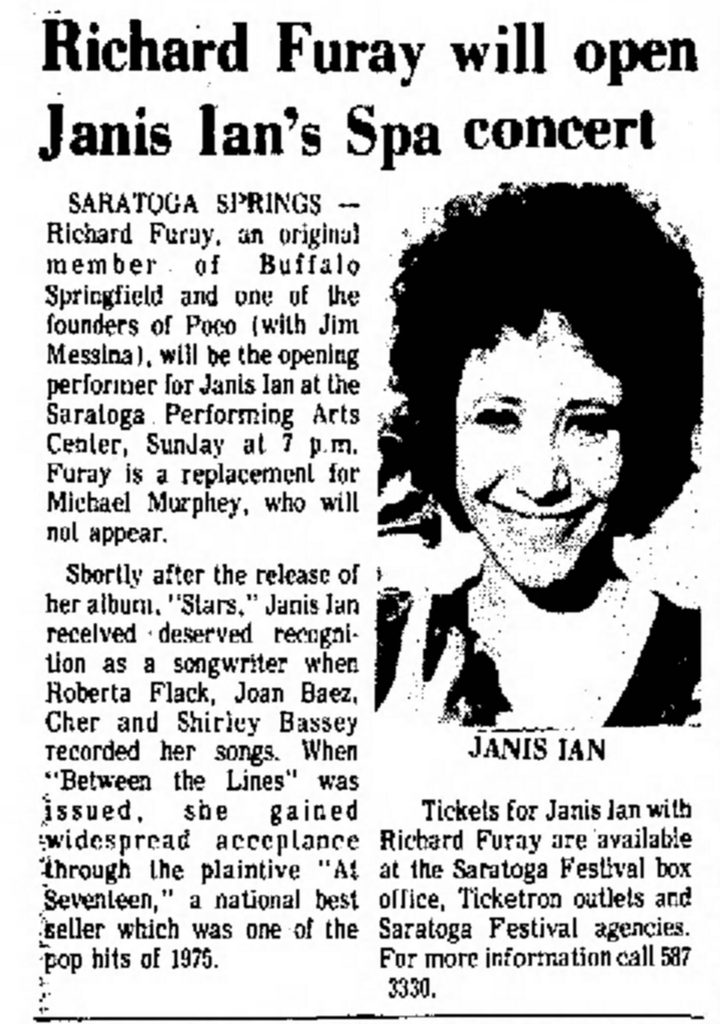
(editor’s note – no ex post facto proof for Richie Furay.)
(editor’s note – Original opener was supposed to be Michael Martin Murphey)
Loneliness and heartstrings
by James J. Hohman, The Knickerbocker News, August 16, 1976
Janis Ian’s stories in songs touch sparse audience
The best part about listening to Janis Ian is understanding her. Unlike so many of her loud-mouthed contemporaries, she is a performer whose words are given a chance to touch the hearts of an audience.
Janis Ian not only sang—and did so beautifully—here Sunday night; she told stories of growing up, of losing love, of giving up, of hoping, of parts of everyone’s life.
It was hard to believe the size of the relatively sparse crowd that braved the nasty weather for a journey to the Saratoga Performing Arts Center. They were justifiably enthusiastic about the diminutive, impish Ian. But, one would have thought there were more fine-music lovers in Metroland.
(At the conclusion of the concert, listeners tried in vain to bring back a hint of her first attempt at the hit “charts.” They asked for a rendition of “Society’s Child,” but the young woman who made the song famous as a scared teenager gently turned down the request.)
And there really was no reason to turn back the pages by 10 years.
What Janis Ian has to offer now is so much richer, wiser and melodic.
“When the Party’s Over” led off the 90-minute performance by Ian and her four-member troupe. It was apparent then that the mood would be mellow, the music soft and the words alive.
Her backup guitars and drums played low-key, never overpowering the crisp, well-defined and throaty voice of the singer.
She is a storyteller, much in the same vein as Harry Chapin, but there could be one essential difference: Chapin seems to recite poetry about people he has seen or known. Ian seems to reach inside herself and transform what she finds into lyrics unmatched anywhere.
And those lyrics revolve around an important theme, at least one that was evident Sunday night: loneliness.
Ian mentioned in several of her songs the word “lonely” and how she worked to come to grips with herself and with those she knew.
By being the stage director, always in command of her music—its pace and volume—she preserved the meaning of her words. All understood them, all understood their message.

The Times Record, August 13, 1976
Recent Comments