(editor’s note – no ex post facto proof for Richie Furay.)
(editor’s note – Original opener was supposed to be Michael Martin Murphey)
Janis Ian Returns A Different Image
by Bob Drzewiczewski, Rutland Daily Herald, August 29, 1972
Janis Ian looks like a troll, sings like Dylan, talks like a New York City taxicab driver, writes like Albert Camus and caresses an electric guitar like Bruce Springsteen.
Yeah, she’s a social and cultural crook. But she loves and admits it.
“Everybody steals something from somebody. It’s just a matter of knowing what to steal and what to do with it,” Miss Ian said after her concert at Saratoga Performing Arts Center here last week.
Her pilfering mixed with a great deal of imagination, wizardry and talent has resulted in three smash albums (Stars, Between the Lines and Aftertones), a blockbuster single (At 17), Carnegie Hall concerts and a nice contract from Columbia.
Not bad for a cultural thief.
No, Janis Ian really isn’t the next person in line to replace Robert Wagner on “It Takes A Thief.” She is just a little different from the average folksinger — that’s all. So what if she’s a little like Dylan, Judy Collins, Pete Seeger, Tom Paxton and Carly Simon.
Somewhere beneath it all there is a Janis Ian.
The search for the person beneath “the party lights” is Janis Ian. And she is as complex as some of her songs that delve into areas that songwriters and folk singers aren’t supposed to delve into.
Now, whoever wrote a song about ugly girls? Janis Ian did. And who would write a song about an inter-racial love affair? Right — Janis Ian.
The song about the inter-racial love affair was Society’s Child, which brought Miss Ian into the national spotlight as a childhood genius at 14. America wasn’t ready to Janis Ian’s probing in 1967.
She gained some fame (but more notoriety) from the top 40 hit. Society’s Child was a starting and finishing point for Janis in under three minutes. It brought her into the recording industry, but it also led her to a self-enforced exile from the same business.
Everybody expected brilliant things from her, but they didn’t materialize until almost 10 years later. The American music-loving public couldn’t wait that long.
So they forgot about her until other people started recording her songs.
Roberta Flack recorded “Jesse” in 1973. The refrain of the song, “Jesse, I’m lonely, come home,” describes the essence of Janis Ian in a line. The “new” Ian deals with the complexities of loneliness.
Now that she’s back with a fresh image, Janis does not look back at her past. Apparently she read Kris Kristofferson’s liner notes quoting Satchel Paige, “Don’t look back, ’cause somebody just might be gaining on you.”
Janis’ dissociation with her past was obvious when the crowd at Saratoga chanted (and almost begged) for Society’s Child. She didn’t sing it, despite the cheers and requests. “That was eight years ago,” she replied, “I don’t remember
the words.”
With a tuna fish and potato chip sandwich in her mouth after the concert, Ian admitted, “You know, it’s been so long since I wrote that song that I just forgot what I wrote about. I’ve written 300 songs since then. How can you expect me to remember one I wrote 10 years ago?”
Her explanation seems weak – most folksingers remember the song that has been “food to them.” Tom Paxton, in particular, always includes “Last Thing on My Mind” (which is a lot older than Society’s Child) in his repertoire. Paxton always (at least in the times I have seen him) acknowledges his debt to the song.
She does, however, have quite a bag of new material. Laced with loneliness, despair and a faint ray of hope, the new Ian sound has been a commercial success.
Let’s face it, without “At 17,” Janis Ian wouldn’t have been invited to appear at Saratoga; it’s as simple as that.
Ian’s performance proved that she has matured since her disappearance from the recording scene. Her material borders on the mellow side, and she presents it well.
The addition of the electric guitar adds some punch to her biting lyrics.
And it sets her apart from the hungry pack of female pop singers. Melissa Manchester doesn’t bounce around stage toting an electric guitar.
“It makes me different, but it’s necessary. I wouldn’t say I was an innovator by using an electric guitar. Dylan was an innovator when he used an electric guitar, though, ” Ian said.
While she succeeds with presenting the sharp-edged aspects of personal relationships, she fails miserably in adding sexual imagery to her work. She simply comes across as a person who talks dirty.
The audience giggled when she made an off-color remark about the dirty book stores of New York City. They fell asleep two minutes later when she tried adding a sexual lyric to her introduction.
She did indicate that she plans to add more sexually-oriented material to her concert and recorded material. If she does, she’ll have to refine some of her material. Some of it’s funny and meaningful, and the rest is just plain dull.
But almost all of her songs are enjoyable.
Her new songs have some appeal and relevance, though they are not as socially motivated as Society’s Child.
“In the Winter” and “I Would Like to Dance” are songs that can be easily identified with.
The power of “At 17” lies in its admission that “I learned the truth at 17, that love was meant for beauty queens, and not for ugly duckling girls like me.”
It would take a miracle for Lily Tomlin to say, “and that’s the truth,” to that.
Ian would like to believe that she is best known for her albums and serious work. That, however, does not seem to be the case.
The audience loves her top 40 stuff, because that’s what they hear. A lot of people who buy records listen exclusively to AM radio.
Her “FM pieces” (non-singles) are for the most part well-constructed technical love poems. She has an obsession with loneliness, non-communication, and futile searches for love and happiness. And then there is her existential material.
It was a surprise that “In the Winter” was chosen by Columbia as a single. In her contract, Ian gives all powers of singles selection to Columbia.
“In the Winter ” is classic Ian. It deals with a chance meeting with a lost lover. Typical. “You have a lovely, and the winter extra blankets for the bed, fix the heater, getting old.”
Time has passed in the song; the feelings are the same, hope is gone, and haven’t you got it nice. In some ways, it sounds as if she plucked it out of a “Mary Hartman, Mary Hartman” episode.
On stage she relates well to her audience. Her voice control and range are excellent. And she plays three instruments well. Possibly in time she’ll do magic tricks too. Yes, she has become commercial. But isn’t that the name of the game.
If imitation is the sincerest form of flattery, Ian has arrived as a serious performer. Her music is growing into such areas as light jazz and soft rock.
Janis Ian seems to be a performer who is constantly seeking new avenues of expression. She will be working on a new album soon. And if her development continues, it is hard to say what will appear on the new disc.
One thing is certain — it’ll be different in some form from her previous material.
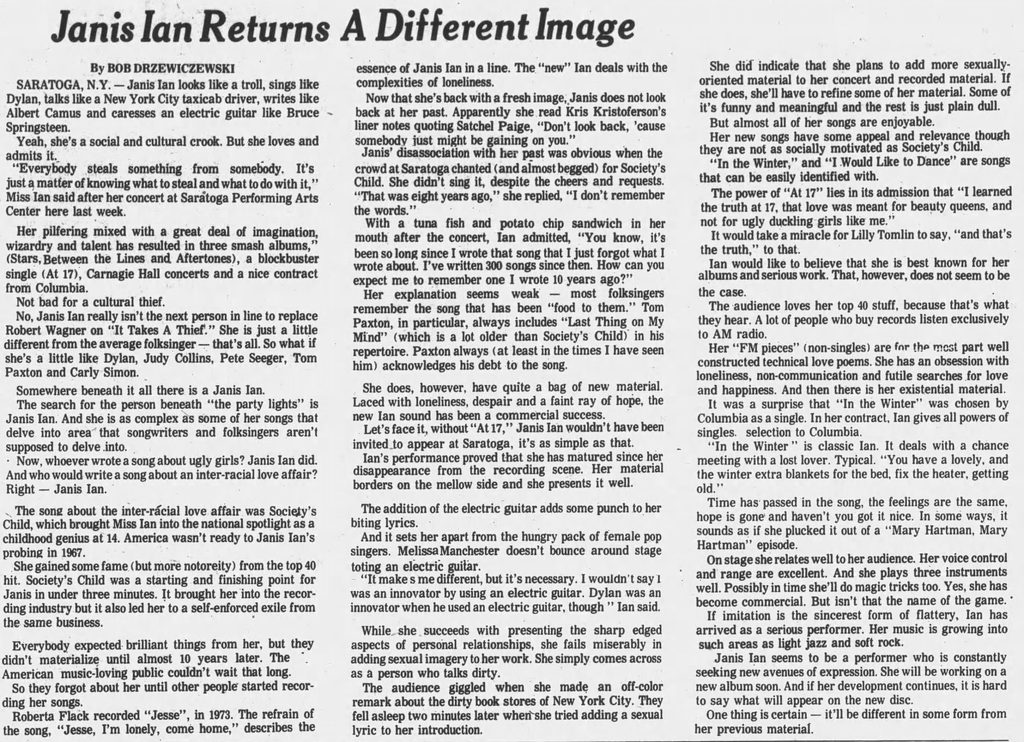
The Times Record, August 13, 1976

Recent Comments