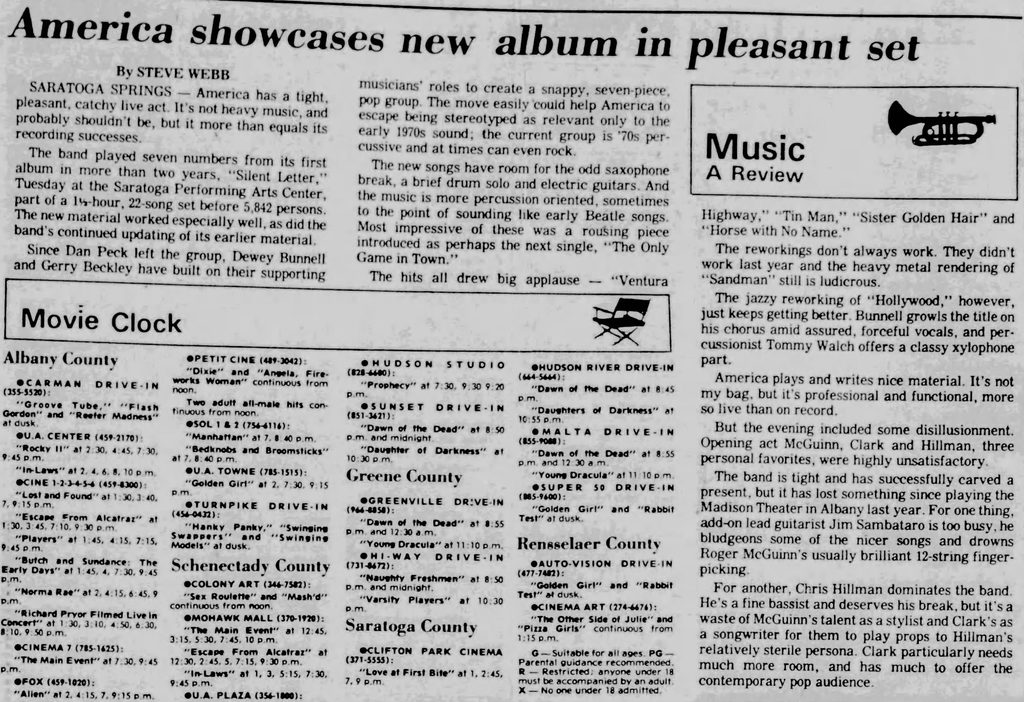
America showcases new album in pleasant set
by Steve Webb, The Knickerbocker News, June 27, 1979
America has a tight, pleasant, catchy live act. It’s not heavy music, and probably shouldn’t be, but it more than equals its recording successes.
The band played seven numbers from its first album in more than two years, “Silent Letter,” Tuesday at the Saratoga Performing Arts Center, part of a 1 1/2-hour, 22-song set before 5,842 persons. The new material worked especially well, as did the band’s continued updating of its earlier material.
Since Dan Peck left the group, Dewey Bunnell and Gerry Beckley have built on their supporting musicians’ roles to create a snappy, seven-piece pop group. The move easily could help America to escape being stereotyped as relevant only to the early 1970s sound; the current group is ’70s percussive and at times can even rock.
The new songs have room for the odd saxophone break, a brief drum solo and electric guitars. And the music is more percussion-oriented, sometimes to the point of sounding like early Beatles songs. Most impressive of these was a rousing piece introduced as perhaps the next single, “The Only Game in Town.”
The hits all drew big applause – “Ventura Highway,” “Tin Man,” “Sister Golden Hair,” and “Horse with No Name.”
The reworkings don’t always work. They didn’t work last year, and the heavy metal rendering of “Sandman” still is ludicrous.
The jazzy reworking of “Hollywood,” however, just keeps getting better. Bunnell growls the title on his chorus amid assured, forceful vocals, and percussionist Tommy Walsh offers a classy xylophone part.
America plays and writes nice material. It’s not my bag, but it’s professional and functional, more so live than on record.
But the evening included some disillusionment. Opening act McGuinn, Clark and Hillman, three personal favorites, were highly unsatisfactory.
The band is tight and has successfully carved a present, but it has lost something since playing the Madison Theater in Albany last year. For one thing, add-on lead guitarist Johnne Sambataro is too busy; he bludgeons some of the nicer songs and drowns Roger McGuinn’s usually brilliant 12-string fingerpicking.
For another, Chris Hillman dominates the band. He’s a fine bassist and deserves his break, but it’s a waste of McGuinn’s talent as a stylist and Clark’s as a songwriter for them to play props to Hillman’s relatively sterile persona. Clark particularly needs much more room, and has much to offer the contemporary pop audience.
Recent Comments