(editor’s note – no ex post facto proof for Molly Bee)
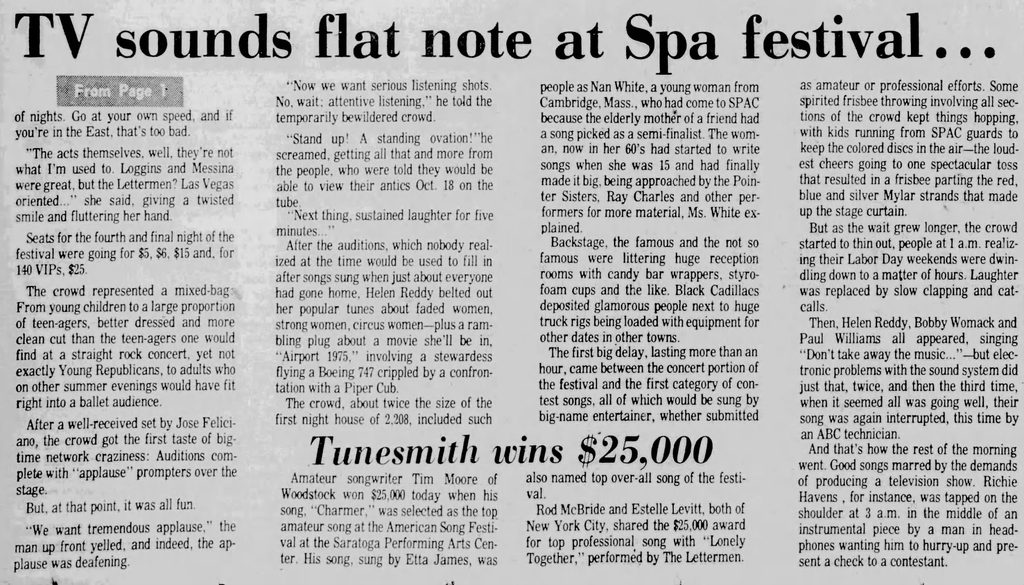
TV sounds flat note at Spa festival …
by Tim Belknap, The Knickerbocker News, September 3, 1974
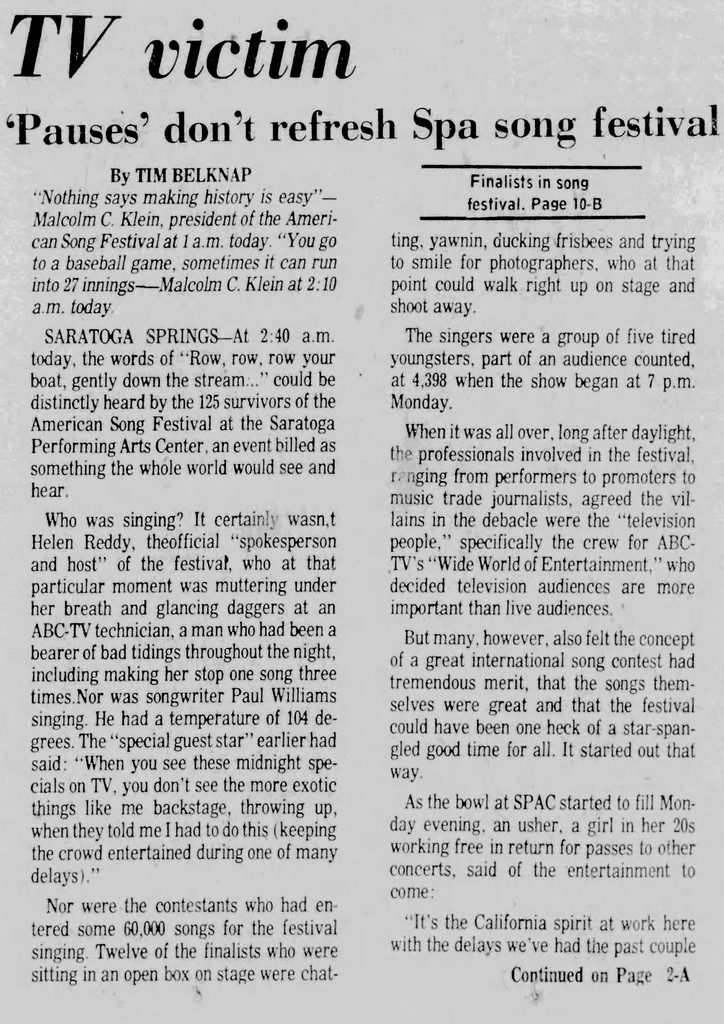
‘Pauses’ don’t refresh Spa song festival
Nothing says making history is easy
– Malcolm C. Klein, president of the American Song Festival at 1 a.m. today
You go to a baseball game, sometimes it can run into 27 innings
-Malcolm C. Klein at 2:10 a.m. today
At 2:40 a.m. today, the words of “Row, row, row your boat, gently down the stream…” could be distinctly heard by the 125 survivors of the American Song Festival at the Saratoga Performing Arts Center, an event billed as something the whole world would see and hear.
Who was singing? It certainly wasn’t Helen Reddy, the official “spokesperson and host” of the festival, who at that particular moment was muttering under her breath and glancing daggers at an ABC-TV technician, a man who had been a bearer of bad tidings throughout the night, including making her stop one song three times. Nor was songwriter Paul Williams singing. He had a temperature of 104 degrees. The “special guest star” earlier had said: “When you see these midnight specials on TV, you don’t see the more exotic things like me backstage, throwing up, when they told me I had to do this (keeping the crowd entertained during one of many delays).”
Nor were the contestants who had entered some 60,000 songs for the festival singing. Twelve of the finalists who were sitting in an open box on stage were chatting, yawning, ducking frisbees and trying to smile for photographers, who at that point could walk right up on stage and shoot away.
The singers were a group of five tired youngsters, part of an audience counted at 4,398 when the show began at 7 p.m. Monday.
When it was all over, long after daylight, the professionals involved in the festival, ranging from performers to promoters to music trade journalists, agreed the villains in the debacle were the television people, specifically the crew for ABC-TV’s “Wide World of Entertainment,” who decided television audiences are more important than live audiences.
But many, however, also felt the concept of a great international song contest had tremendous merit, that the songs themselves were great and that the festival could have been one heck of a star-spangled good time for all. It started out that way.
As the bowl at SPAC started to fill Monday evening, an usher, a girl in her 20s working free in return for passes to other concerts, said of the entertainment to come: “It’s the California spirit at work here with the delays we’ve had the past couple of nights. Go at your own speed, and if you’re in the East, that’s too bad.
“The acts themselves, well, they’re not what I’m used to. Loggins and Messina were great, but the Lettermen? Las Vegas-oriented,” she said, giving a twisted smile and fluttering her hand.
Seats for the fourth and final night of the festival were going for $5, $6, $15, and 140 VIPs, $25.
The crowd represented a mixed bag, from young children to a large proportion of teenagers, better dressed and more clean-cut than the teenagers one would find at a straight rock concert, yet not exactly Young Republicans, to adults who on other summer evenings would have fit right into a ballet audience.
After a well-received set by Jose Feliciano, the crowd got the first taste of big-time network craziness: Auditions complete with “applause” prompters over the stage.
But, at that point, it was all fun.
“We want tremendous applause,” the man up front yelled, and indeed, the applause was deafening.
“Now we want serious listening shots. No, wait: attentive listening,” he told the temporarily bewildered crowd.
“Stand up! A standing ovation!” he screamed, getting all that and more from the people, who were told they would be able to view their antics Oct. 18 on the tube.
“Next thing, sustained laughter for five minutes…”
After the auditions, which nobody realized at the time would be used to fill in after songs sung when just about everyone had gone home, Helen Reddy belted out her popular tunes about faded women, strong women, circus women—plus a rambling plug about a movie she’ll be in, “Airport 1975,” involving a stewardess flying a Boeing 747 crippled by a confrontation with a Piper Cub.
The crowd, about twice the size of the first night house of 2,208, included such people as Nan White, a young woman from Cambridge, Mass., who had come to SPAC because the elderly mother of a friend had a song picked as a semi-finalist. The woman, now in her 60s, had started to write songs when she was 15 and had finally made it big, being approached by the Pointer Sisters, Ray Charles and other performers for more material, Ms. White explained.
Backstage, the famous and the not so famous were littering huge reception rooms with candy bar wrappers, styrofoam cups and the like. Black Cadillacs deposited glamorous people next to huge truck rigs being loaded with equipment for other dates in other towns.
The first big delay, lasting more than an hour, came between the concert portion of the festival and the first category of contest songs, all of which would be sung by big-name entertainer, whether submitted as amateur or professional efforts. Some spirited frisbee throwing involving all sections of the crowd kept things hopping, with kids running from SPAC guards to keep the colored discs in the air—the loudest cheers going to one spectacular toss that resulted in a frisbee parting the red, blue and silver Mylar strands that made up the stage curtain.
But as the wait grew longer, the crowd started to thin out, people at 1 a.m. realizing their Labor Day weekends were dwindling down to a matter of hours. Laughter was replaced by slow clapping and catcalls.
Then, Helen Reddy, Bobby Womack and Paul Williams all appeared, singing “Don’t take away the music…”—but electronic problems with the sound system did just that, twice, and then the third time, when it seemed all was going well, their song was again interrupted, this time by an ABC technician.
And that’s how the rest of the morning went. Good songs marred by the demands of producing a television show. Richie Havens, for instance, was tapped on the shoulder at 3 a.m. in the middle of an instrumental piece by a man in headphones wanting him to hurry up and present a check to a contestant.
Recent Comments