Crosby, Stills & Nash relive the myth
by Ken Marks, The Berkshire Sampler, June 26, 1977
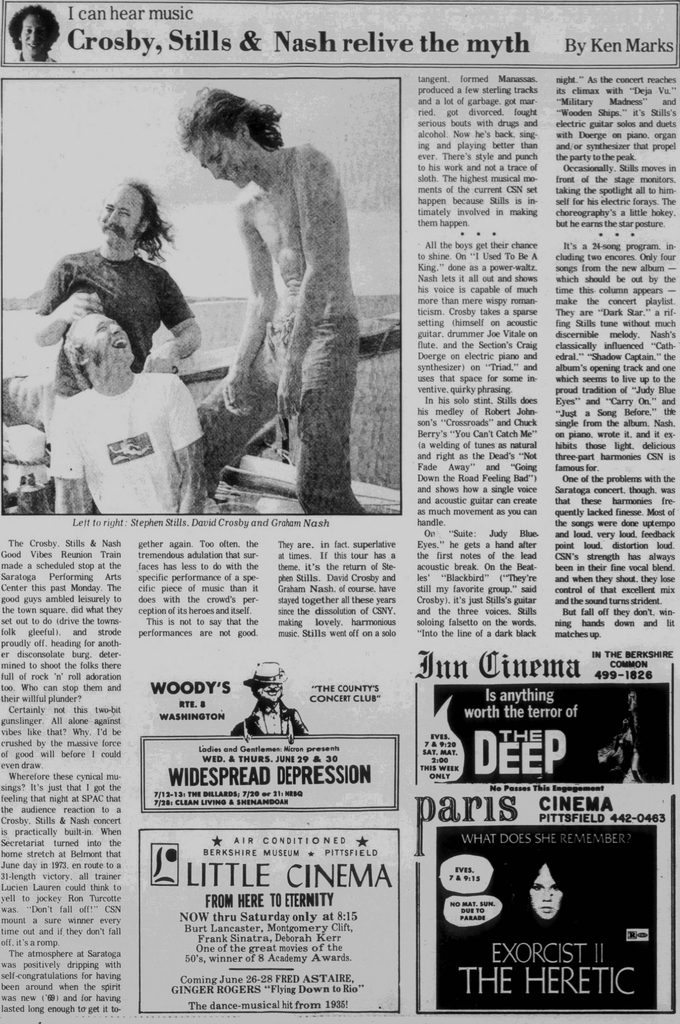
The Crosby, Stills & Nash Good Vibes Reunion Train made a scheduled stop at the Saratoga Performing Arts Center this past Monday. The good guys ambled leisurely to the town square, did what they set out to do (drive the townsfolk gleeful), and strode proudly off, heading for another disconsolate burg, determined to shoot the folks there full of rock ‘n’ roll adoration too. Who can stop them and their willful plunder?
Certainly not this two-bit gunslinger. All alone against vibes like that? Why, I’d be crushed by the massive force of good will before I could even draw.
Wherefore these cynical musings? It’s just that I got the feeling that night at SPAC that the audience reaction to a Crosby, Stills & Nash concert is practically built-in. When Secretariat turned into the home stretch at Belmont that June day in 1973, en route to a 31-length victory, all trainer Lucien Lauren could think to yell to jockey Ron Turcotte was, “Don’t fall off!” CSN mount a sure winner every time out, and if they don’t fall off, it’s a romp.
The atmosphere at Saratoga was positively dripping with self-congratulations for having been around when the spirit was new (’69) and for having lasted long enough to get it together again. Too often, the tremendous adulation that surfaces has less to do with the specific performance of a specific piece of music than it does with the crowd’s perception of its heroes and itself.
This is not to say that the performances are not good. They are, in fact, superlative at times. If this tour has a theme, it’s the return of Stephen Stills. David Crosby and Graham Nash, of course, have stayed together all these years since the dissolution of CSNY, making lovely, harmonious music. Stills went off on a solo tangent, formed Manassas, produced a few sterling tracks and a lot of garbage, got married, got divorced, fought serious bouts with drugs and alcohol. Now he’s back, singing and playing better than ever. There’s style and punch to his work and not a trace of sloth. The highest musical moments of the current CSN set happen because Stills is in timately involved in making them happen.
***
All the boys get their chance to shine. On “I Used To Be A King,” done as a power-waltz, Nash lets it all out and shows his voice is capable of much more than mere wispy romanticism. Crosby takes a sparse setting (himself on acoustic guitar, drummer Joe Vitale on flute, and the Section’s Craig Doerge on electric piano and synthesizer) on “Triad,” and uses that space for some inventive, quirky phrasing.
In his solo stint, Stills does his medley of Robert Johnson’s “Crossroads” and Chuck Berry’s “You Can’t Catch Me” (a welding of tunes as natural and right as the Dead’s “Not Fade Away” and “Going Down the Road Feeling Bad”) and shows how a single voice and acoustic guitar can create as much movement as you can handle.
On “Suite: Judy Blue Eyes,” he gets a hand after the first notes of the lead acoustic break. On the Beatles’ “Blackbird” (They’re still my favorite group,” said Crosby), it’s just Stills’ guitar and the three voices. Stills soloing falsetto on the words, “Into the line of a dark black night.” As the concert reaches its climax with “Deja Vu,” “Military Madness,” and “Wooden Ships,” it’s Stills’ electric guitar solos and duets with Doerge on piano, organ and/or synthesizer that propel the party to the peak.
Occasionally, Stills moves in front of the stage monitors, taking the spotlight all to himself for his electric forays. The choreography’s a little hokey, but he earns the star posture.
***
It’s a 24-song program, including two encores. Only four songs from the new album — which should be out by the time this column appears — make the concert playlist. They are “Dark Star,” a riffing Stills tune without much discernible melody. Nash’s classically influenced “Cathedral.” “Shadow Captain,” the album’s opening track and one which seems to live up to the proud tradition of “Judy Blue Eyes” and “Carry On.” And “Just a Song Before,” the single from the album. Nash, on piano, wrote it, and it exhibits those light, delicious three-part harmonies CSN is famous for.
One of the problems with the Saratoga concert, though, was that these harmonies frequently lacked finesse. Most of the songs were done uptempo and loud,very loud, feedback point loud, distortion loud. CSN’s strength has always been in their fine vocal blend, and when they shout, they lose control of that excellent mix and the sound turns strident.
But fall off they dont, winning hands down and lit matches up.
Recent Comments