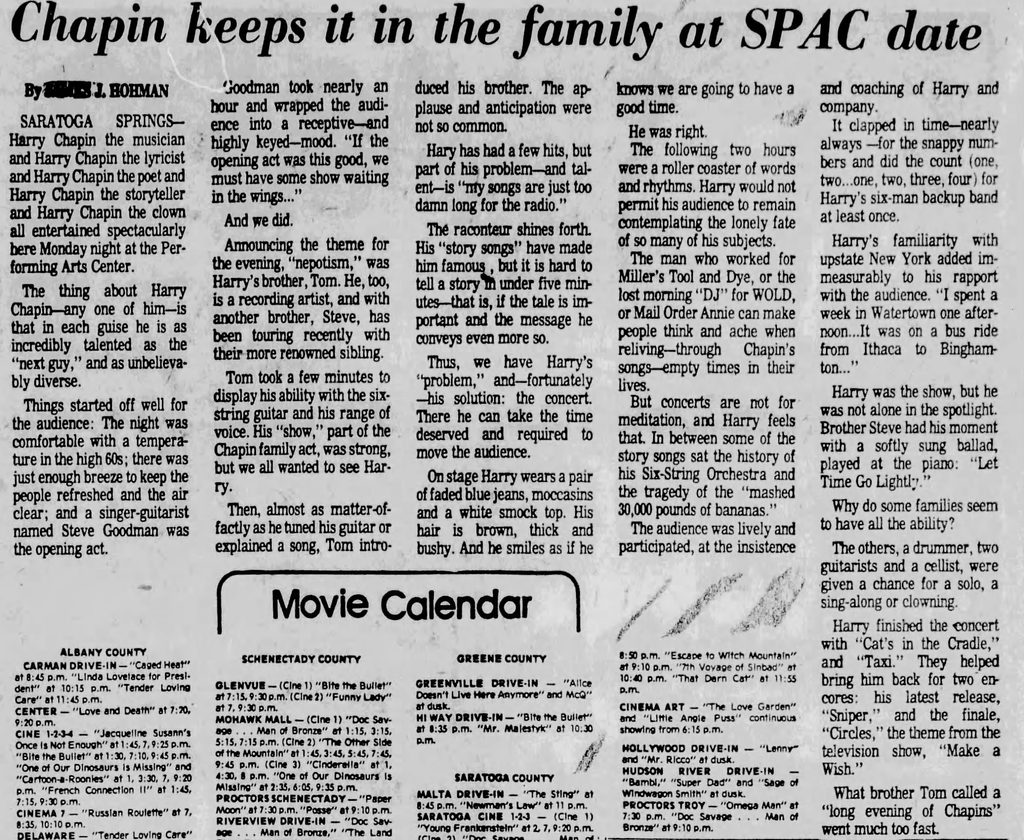
Chapin keeps it in the family at SPAC date
by James J. Hohman, The Knickerbocker News, July 29, 1975
Harry Chapin the musician and Harry Chapin the lyricist and Harry Chapin the poet and Harry Chapin the storyteller and Harry Chapin the clown all entertained spectacularly here Monday night at the Performing Arts Center.
The thing about Harry Chapin—any one of him—is that in each guise he is as incredibly talented as the “next guy,” and as unbelievably diverse.
Things started off well for the audience: The night was comfortable with a temperature in the high 60s; there was just enough breeze to keep the people refreshed and the air clear; and a singer-guitarist named Steve Goodman was the opening act.
Goodman took nearly an hour and wrapped the audience into a receptive and highly keyed mood. “If the opening act was this good, we must have some show waiting in the wings…”
And we did.
Announcing the theme for the evening, “nepotism,” was Harry’s brother, Tom. He, too, is a recording artist, and with another brother, Steve, has been touring recently with their more renowned sibling.
Tom took a few minutes to display his ability with the six-string guitar and his range of voice. His “show,” part of the Chapin family act, was strong, but we all wanted to see Harгу.
Then, almost as matter-of-factly as he tuned his guitar or explained a song, Tom introduced his brother. The applause and anticipation were not so common.
Harry has had a few hits, but part of his problem—and talent—is “my songs are just too damn long for the radio.”
The raconteur shines forth. His “story songs” have made him famous, but it is hard to tell a story in under five minutes that is, if the tale is important and the message he conveys even more so.
Thus, we have Harry’s “problem,” and—fortunately—his solution: the concert. There he can take the time deserved and required to move the audience.
On stage Harry wears a pair of faded blue jeans, moccasins and a white smock top. His hair is brown, thick and bushy. And he smiles as if he knows we are going to have a good time.
He was right.
The following two hours were a roller coaster of words and rhythms. Harry would not permit his audience to remain contemplating the lonely fate of so many of his subjects.
The man who worked for Miller’s Tool and Dye, or the lost morning “DJ” for WOLD, or Mail Order Annie can make people think and ache when reliving—through Chapin’s songs—empty times in their lives.
But concerts are not for meditation, and Harry feels that. In between some of the story songs sat the history of his Six-String Orchestra and the tragedy of the “mashed 30,000 pounds of bananas.”
The audience was lively and participated, at the insistence and coaching of Harry and company.
It clapped in time—nearly always—for the snappy numbers and did the count (one, two…one, two, three, four) for Harry’s six-man backup band at least once.
Harry’s familiarity with upstate New York added immeasurably to his rapport with the audience. “I spent a week in Watertown one afternoon…It was on a bus ride from Ithaca to Binghamton…”
Harry was the show, but he was not alone in the spotlight. Brother Steve had his moment with a softly sung ballad, played at the piano: “Let Time Go Lightly. “
Why do some families seem to have all the ability?
The others, a drummer, two guitarists, and a cellist, were given a chance for a solo, a sing-along, or clowning.
Harry finished the concert with “Cat’s in the Cradle” and “Taxi.” They helped bring him back for two encores: his latest release, “Sniper,” and the finale, “Circles,” the theme from the television show, “Make a Wish.”
What brother Tom called a “long evening of Chapins” went much too fast.
Recent Comments