Folk great Joan Baez stays ‘forever young’
by Steve Webb, The Knickerbocker News, June 26, 1979
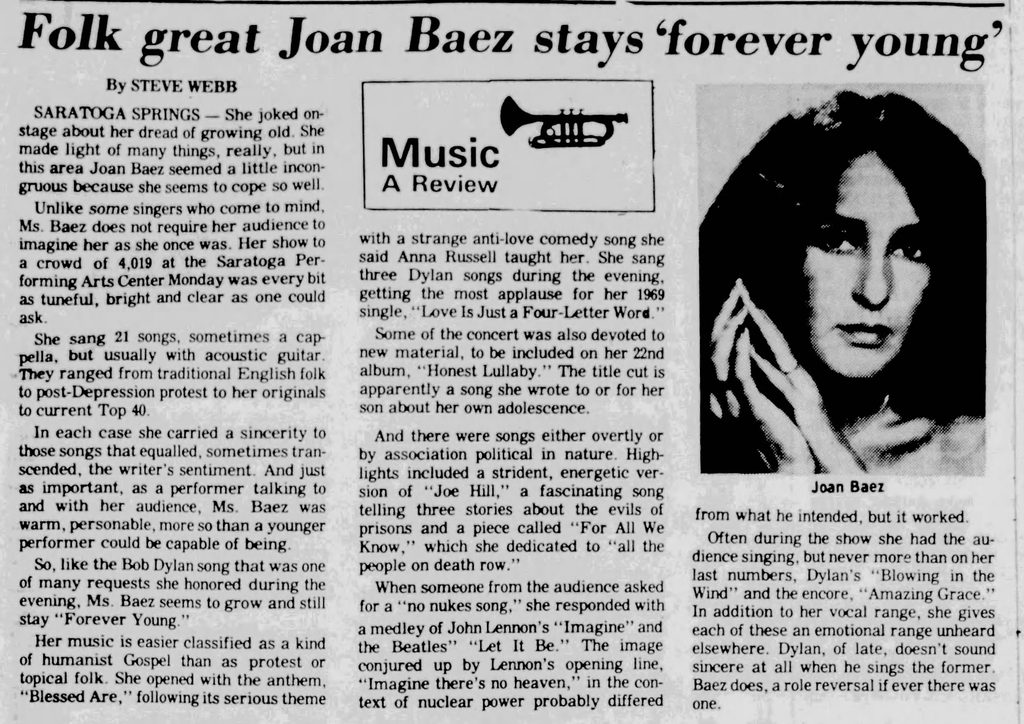
She joked onstage about her dread of growing old. She made light of many things, really, but in this area Joan Baez seemed a little incongruous because she seems to cope so well.
Unlike some singers who come to mind, Ms. Baez does not require her audience to imagine her as she once was. Her show to a crowd of 4,019 at the Saratoga Performing Arts Center Monday was every bit as tuneful, bright and clear as one could ask.
She sang 21 songs, sometimes a cappella, but usually with acoustic guitar. They ranged from traditional English folk to post-Depression protest to her originals to current Top 40.
In each case she carried a sincerity to those songs that equalled, sometimes transcended, the writer’s sentiment. And just as important, as a performer talking to and with her audience, Ms. Baez was warm, personable, more so than a younger performer could be capable of being.
So, like the Bob Dylan song that was one of many requests she honored during the evening, Ms. Baez seems to grow and still stay “Forever Young.”
Her music is easier classified as a kind of humanist Gospel than as protest or topical folk. She opened with the anthem, “Blessed Are,” following its serious theme with a strange anti-love comedy song she said Anna Russell taught her. She sang three Dylan songs during the evening, getting the most applause for her 1969 single, “Love Is Just a Four-Letter Word.”
Some of the concert was also devoted to new material, to be included on her 22nd album, “Honest Lullaby.” The title cut is apparently a song she wrote to or for her son about her own adolescence.
And there were songs either overtly or by association political in nature. Highlights included a strident, energetic version of “Joe Hill,” a fascinating song telling three stories about the evils of prisons, and a piece called “For All We Know,” which she dedicated to “all the people on death row.”
When someone from the audience asked for a “no nukes song,” she responded with a medley of John Lennon’s “Imagine” and the Beatles’ “Let It Be.” The image conjured up by Lennon’s opening line, “Imagine there’s no heaven,” in the context of nuclear power probably differed from what he intended, but it worked.
Often during the show she had the audience singing, but never more than on her last numbers, Dylan’s “Blowin’ in the Wind” and the encore, “Amazing Grace.” In addition to her vocal range, she gives each of these an emotional range unheard elsewhere. Dylan, of late, doesn’t sound sincere at all when he sings the former. Baez does, a role reversal if ever there was one.
Recent Comments