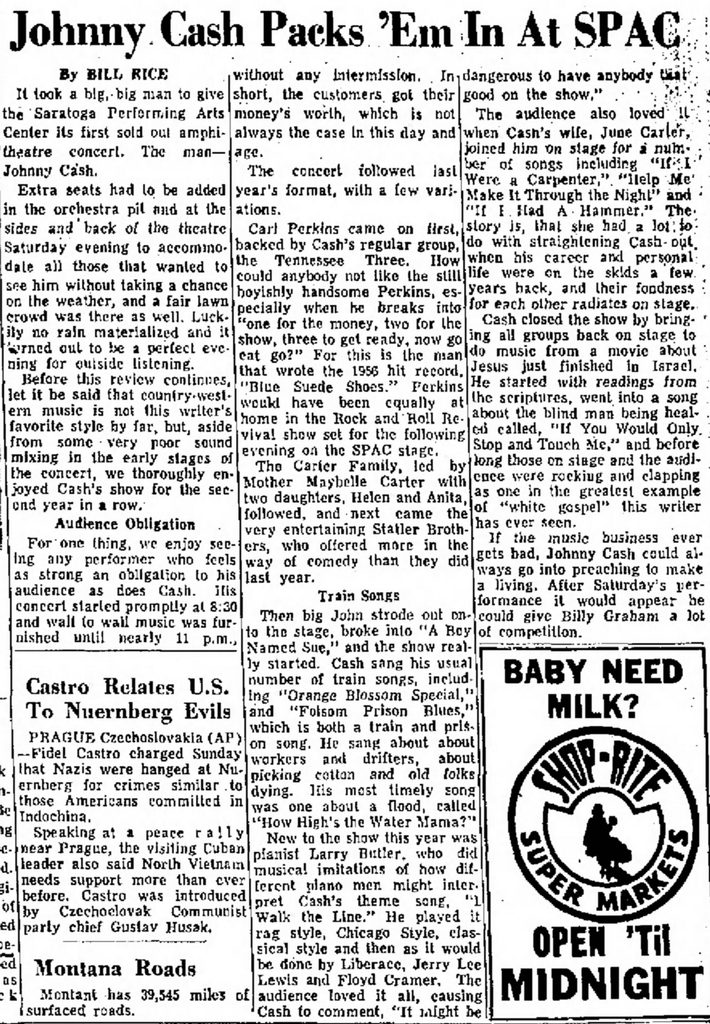
Johnny Cash Packs ‘Em In At SPAC
by Bill Rice, The Troy Record, June 26, 1972
It took a blg, big man to give the Saratoga Performing Arts Center its first sold out amphitheatre concert. The man—Johnny Cash.
Extra seats had to be added in the orchestra pit and at the sides and back of the theatre Saturday evening to accommodate all those that wanted to see him without taking a chance on the weather, and a fair lawn crowd was there as well. Luckily no rain materialized and it turned out to be a perfect evening for outside listening.
Before this review continues, let it be said that country western music is not this writer’s favorite style by far, but, aside from some very poor sound mixing in the early stages of the concert, we thoroughly enjoyed Cash’s show for the second year in a row.
Audience Obligation
For one thing, we enjoy seeing any performer who feels as strong an obligation to his audience as does Cash. His concert started promptly at 8:30 and wall to wall music was furnished until nearly 11 p.m., without any Intermission. In short, the customers got their money’s worth, which is not always the case in this day and age.
The concert followed last year’s format, with a few variations.
Carl Perkins came on first, backed by Cash’s regular group, the Tennessee Three. How could anybody not like the still boyishly handsome Perkins, especially when he breaks into “one for the money, two for the show, three to get ready, now go cat go?” For this is the man that wrote the 1956 hit record, “Blue Suede Shoes.” Perkins would have been equally at home in the Rock and Roll Revival show set for the following evening on the SPAC stage
The Carter Family, led by Mother Maybelle Carter with two daughters, Helen and Anita, followed, and next came the
very entertaining Statler Brothers, who offered more in the way of comedy than they did last year.
Train Songs
Then big John strode out onto the stage, broke into “A Boy Named Sue,” and the show really started. Cash sang his usual number of train songs, including “Orange Blossom Special” and “Folsom Prison Blues,” which is both a train and prison song. He sang about workers and drifters, about picking cotton and old folks dying. His most timely song was one about a flood, called “How High’s the Water Mama?”
New to the show this year was pianist Larry Bulter, who did musical imitations of how different piano men might interpret Cash’s theme song, “I Walk the Line.” He played it rag style, Chicago Style, classical style and then as it would be done by Liberace, Jerry Lee Lewis and Floyd Cramer. The audience loved it all, causing Cash to comment, “It might be dangerous to have anybody that good on the show.”
The audience also loved it when Cash’s wife, June Carter, joined him on stage for a number of songs including “If I Were a Carpenter,” “Help Me Make It Through the Night” and “If I Had A Hammer.” The story is, that she had a lot to do with straightening Cash out when his career and personal life were on the skids a few years back, and their fondness for each other radiates on stage.
Cash closed the show by bringing all groups back on stage to do music from a movie about Jesus just finished in Israel. He started with readings from the scriptures, went into a song about the blind man being healed called, “If You Would Only Stop and Touch Me,” and before long those on stage and the audience were rocking and clapping as one in the greatest example of “white gospel” this writer has ever seen.
lf the music business ever gets bad, Johnny Cash could always go into preaching to make a living. After Saturday’s performance it would appear he could give Billy Graham a lot of competition.
Recent Comments