(editor’s note – no ex post facto proof for Sweet)
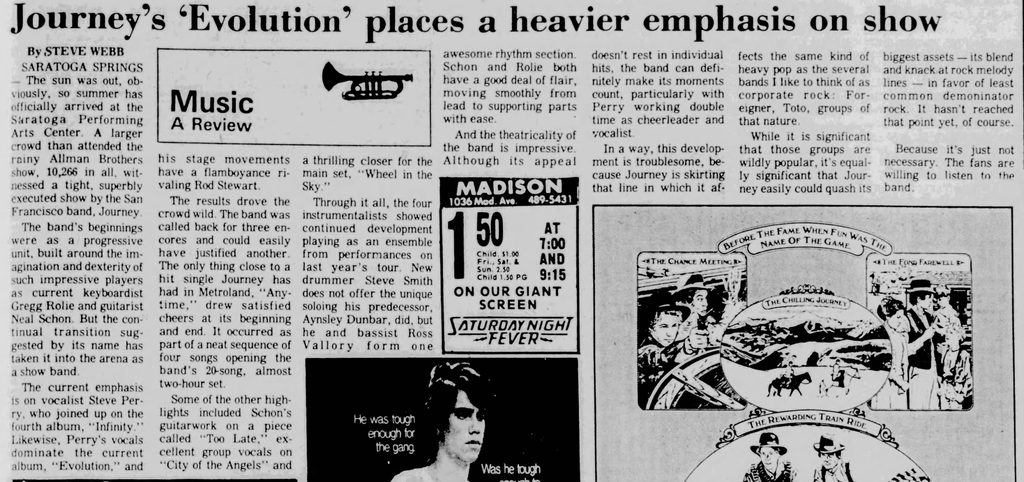
Journey’s ‘Evolution’ places a heavier emphasis on show
by Steve Webb, The Knickerbocker News, June 16, 1979
The sun was out, obviously, so summer has officially arrived at the Saratoga Performing Arts Center. A larger crowd than attended the rainy Allman Brothers show, 10,266 in all, witnessed a tight, superbly executed show by the San Francisco band, Journey.
The band’s beginnings were as a progressive unit, built around the imagination and dexterity of such impressive players as current keyboardist Gregg Rolie and guitarist Neal Schon. But the continual transition suggested by its name has taken it into the arena as a show band.
The current emphasis is on vocalist Steve Perry, who joined up on the fourth album, “Infinity.” Likewise, Perry’s vocals dominate the current album, “Evolution,” and his stage movements have a flamboyance rivaling Rod Stewart.
The results drove the crowd wild. The band was called back for three encores and could easily have justified another. The only thing close to a hit single Journey has had in Metroland, “Anytime,” drew satisfied cheers at its beginning and end. It occurred as part of a neat sequence of four songs opening the band’s 20-song, almost two-hour set.
Some of the other highlights included Schon’s guitar work on a piece called “Too Late,” excellent group vocals on “City of the Angels” and a thrilling closer for the main set, “Wheel in the Sky.”
Through it all, the four instrumentalists showed continued development playing as an ensemble from performances on last year’s tour. New drummer Steve Smith does not offer the unique soloing his predecessor, Aynsley Dunbar, did, but he and bassist Ross Vallory form one awesome rhythm section. Schon and Rolie both have a good deal of flair, moving smoothly from lead to supporting parts with ease.
And the theatricality of the band is impressive. Although its appeal doesn’t rest in individual hits, the band can definitely make its moments count, particularly with Perry working double time as cheerleader and vocalist.
In a way, this development is troublesome, because Journey is skirting that line in which it affects the same kind of heavy pop as the several bands I like to think of as corporate rock: Foreigner, Toto, groups of that nature.
While it is significant that those groups are wildly popular, it’s equally significant that Journey easily could quash its biggest assets – its blend and knack at rock melody lines – in favor of least-common-denominator rock. It hasn’t reached that point yet, of course.
Because it’s just not necessary. The fans are willing to listen to the band.
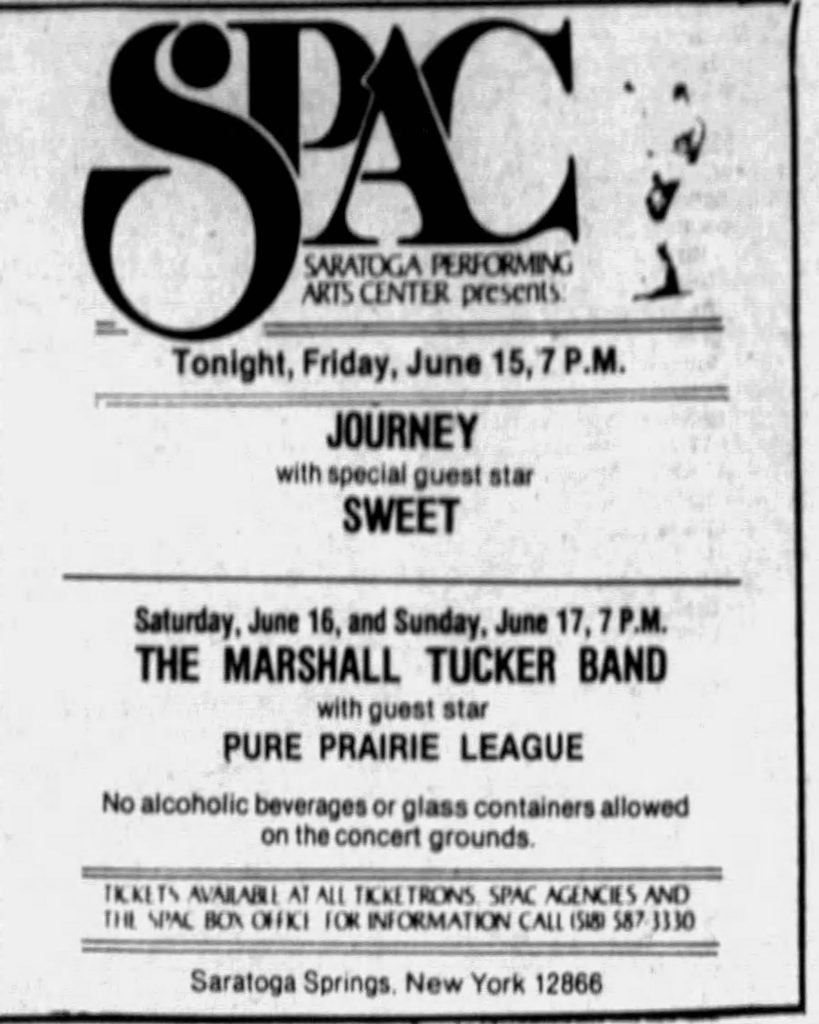
The Post-Star, June 15, 1979
Recent Comments