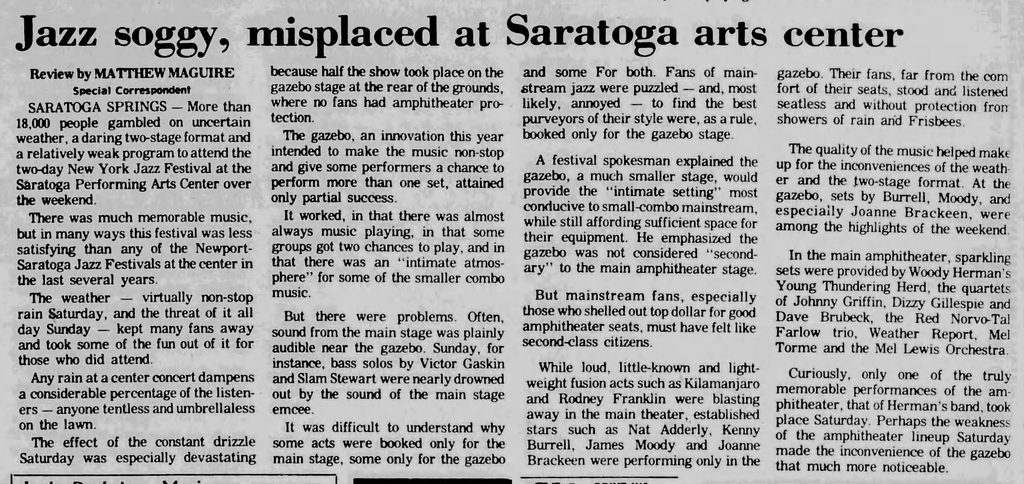
Jazz soggy, misplaced at Saratoga arts center
by Matthew Maguire, The Knickerbocker News, June 22, 1981
More than 18,000 people gambled on uncertain weather, a daring two-stage format and a relatively weak program to attend the two-day New York Jazz Festival at the Saratoga Performing Arts Center over the weekend.
There was much memorable music, but in many ways this festival was less satisfying than any of the Newport-Saratoga Jazz Festivals at the center in the last several years.
The weather — virtually non-stop rain Saturday, and the threat of it all day Sunday — kept many fans away and took some of the fun out of it for those who did attend.
Any rain at a center concert dampens a considerable percentage of the listeners — anyone tentless and umbrellaless
on the lawn.
The effect of the constant drizzle Saturday was especially devastating because half the show took place on the gazebo stage at the rear of the grounds, where no fans had amphitheater protection.
The gazebo, an innovation this year intended to make the music non-stop and give some performers a chance to perform more than one set, attained only partial success.
It worked, in that there was almost always music playing, in that some groups got two chances to play, and in that there was an “intimate atmosphere” for some of the smaller combo music.
But there were problems. Often, sound from the main stage was plainly audible near the gazebo. Sunday, for instance, bass solos by Victor Gaskin and Slam Stewart were nearly drowned out by the sound of the main stage emcee.
It was difficult to understand why some acts were booked only for the main stage, some only for the gazebo and some for both. Fans of mainstream jazz were puzzled — and, most likely, annoyed — to find the best purveyors of their style were, as a rule, booked only for the gazebo stage.
A festival spokesman explained the gazebo, a much smaller stage, would provide the “intimate setting” most conducive to small-combo mainstream, while still affording sufficient space for their equipment. He emphasized the gazebo was not considered “secondary” to the main amphitheater stage.
But mainstream fans, especially those who shelled out top dollar for good amphitheater seats, must have felt like second-class citizens.
While loud, little-known and lightweight fusion acts such as Kilimanjaro and Rodney Franklin were blasting away in the main theater, established stars such as Nat Adderley, Kenny Burrell, James Moody and Joanne Brackeen were performing only in the gazebo. Their fans, far from the comfort of their seats, stood and listened, seatless and without protection from showers of rain and Frisbees.
The quality of the music helped make up for the inconveniences of the weather and the two-stage format. At the gazebo, sets by Burrell, Moody, and especially Joanne Brackeen were among the highlights of the weekend.
In the main amphitheater, sparkling sets were provided by Woody Herman’s Young Thundering Herd, the quartets of Johnny Griffin, Dizzy Gillespie and Dave Brubeck, the Red Norvo-Tal Farlow trio, Weather Report, Mel Torme and the Mel Lewis Orchestra.
Curiously, only one of the truly memorable performances of the amphitheater, that of Herman’s band, took place Saturday. Perhaps the weakness of the amphitheater lineup Saturday made the inconvenience of the gazebo that much more noticeable.
Recent Comments