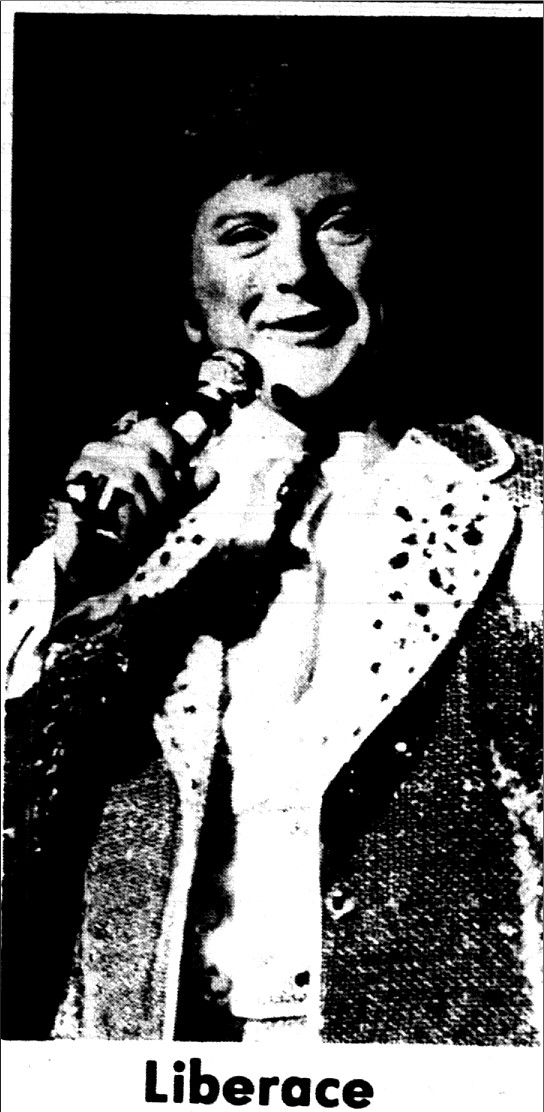
Liberace–‘Mr. Showmanship’
by Marilyn Moran, The Saratogian
SPAC crowds get ‘money’s worth’
Audiences at the Saratoga Performing Arts Center learned firsthand Sunday how Liberace comes to be called “Mr. Showmanship.” At afternoon and evening performances at the center, he gave them their money’s worth and more of pure and fanciful entertainment. Attendance at each show was approximately 5.400, according to SPAC officials.
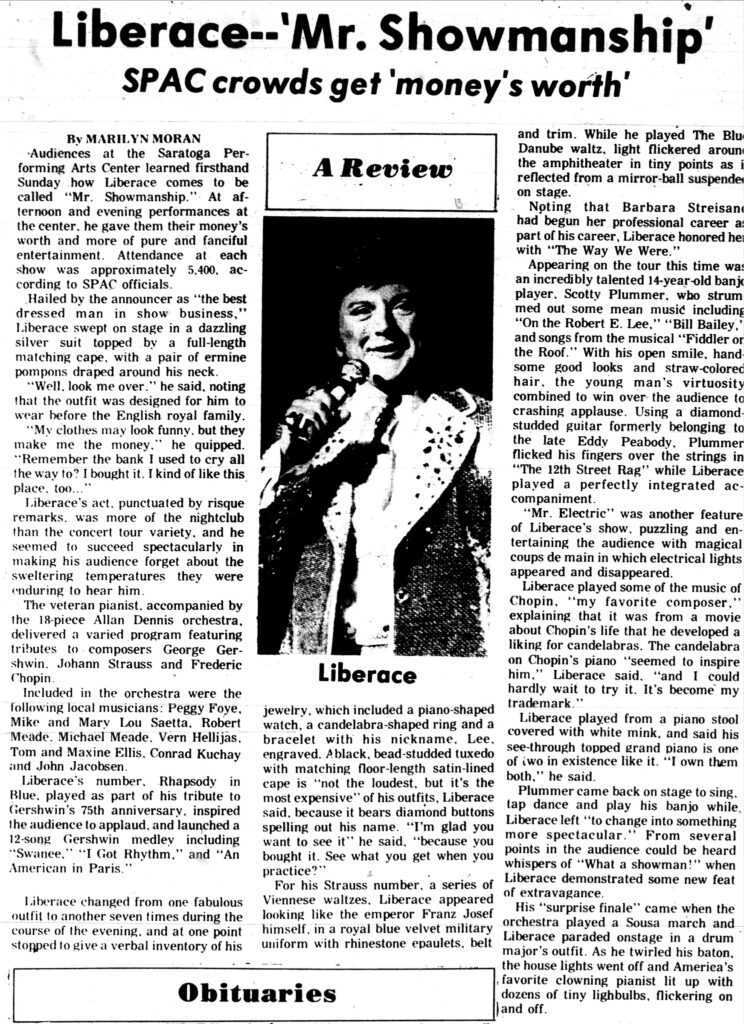
Hailed by the announcer as “the best dressed man in show business,” Liberace swept on stage in a dazzling silver suit topped by a full-length matching cape, with a pair of ermine pompons draped around his neck.
“Well, look me over,” he said, noting that the outfit was designed for him to wear before the English royal family.
*My clothes may look funny, but they make me the money,” he quipped. “Remember the bank I used to cry all the way to? I bought it. I kind of like this place, too…”
Liberace’s act, punctuated by risque remarks, was more of the nightclub than the concert tour variety, and he seemed to succeed spectacularly in making his audience forget about the sweltering temperatures they were enduring to hear him.
The veteran pianist, accompanied by the 18-piece Allan Dennis orchestra, delivered a varied program featuring tributes to composers George Gershwin, Johann Strauss and Frederic Chopin.
Included in the orchestra were the following local musicians: Peggy Foye, Mike and Mary Lou Saetta, Robert Meade, Michael Meade, Vern Hellijas, Tom and Maxine Ellis, Conrad Kuchay and John Jacobsen.
Liberace’s number, Rhapsody in Blue, played as part of his tribute to Gershwin’s 75th anniversary, inspired the audience to applaud, and launched a 12-song Gershwin medley including “Swanee,” “I Got Rhythm,” and “An American in Paris.”
Liberace changed from one fabulous outfit to another seven times during the course of the evening, and at one point stopped to give a verbal inventory of his jewelry, which included a piano-shaped watch, a candelabra-shaped ring and a bracelet with his nickname, Lee, engraved. A black, bead-studded tuxedo with matching floor-length satin-lined cape is “not the loudest, but it’s the most expensive” of his outfits, Liberace said, because it bears diamond buttons spelling out his name. “I’m glad you want to see it” he said, “because you bought it. See what you get when you practice?”
For his Strauss number, a series of Viennese waltzes, Liberace appeared looking like the emperor Franz Josef himself, in a royal blue velvet military uniform with rhinestone epaulets, belt and trim. While he played The Blue Danube waltz, light flickered around the amphitheater in tiny points as it reflected from a mirror ball suspended on stage.
Noting that Barbara Streisand had begun her professional career as part of his career, Liberace honored her with “The Way We Were.”
Appearing on the tour this time was an incredibly talented 14-year-old banjo player, Scotty Plummer, who strummed out some mean music including “On the Robert E. Lee.” “Bill Bailey,” and songs from the musical “Fiddler on the Roof.” With his open smile, handsome good looks and straw-colored hair, the young man’s virtuosity combined to win over the audience to crashing applause. Using a diamond-studded guitar formerly belonging to the late Eddy Peabody, Plummer flicked his fingers over the strings in “The 12th Street Rag” while Liberace played a perfectly integrated accompaniment.
“Mr. Electric” was another feature of Liberace’s show, puzzling and entertaining the audience with magical coups de main in which electrical lights appeared and disappeared.
Liberace played some of the music of Chopin, “my favorite composer,” explaining that it was from a movie about Chopin’s life that he developed a liking for candelabras. The candelabra on Chopin’s piano “seemed to inspire him,” Liberace said, “and I could hardly wait to try it. It’s become my trademark.”
Liberace played from a piano stool covered with white mink, and said his see-through-topped grand piano is one of two in existence like it. “I own them both,” he said.
Plummer came back on stage to sing, tap dance and play his banjo while Liberace left “to change into something more spectacular.” From several points in the audience could be heard whispers of “What a showman!” when Liberace demonstrated some new feat of extravagance.
His “surprise finale” came when the orchestra played a Sousa march and Liberace paraded onstage in a drum major’s outfit. As he twirled his baton, the house lights went off and America’s favorite clowning pianist lit up with dozens of tiny lightbulbs, flickering on and off.
Recent Comments