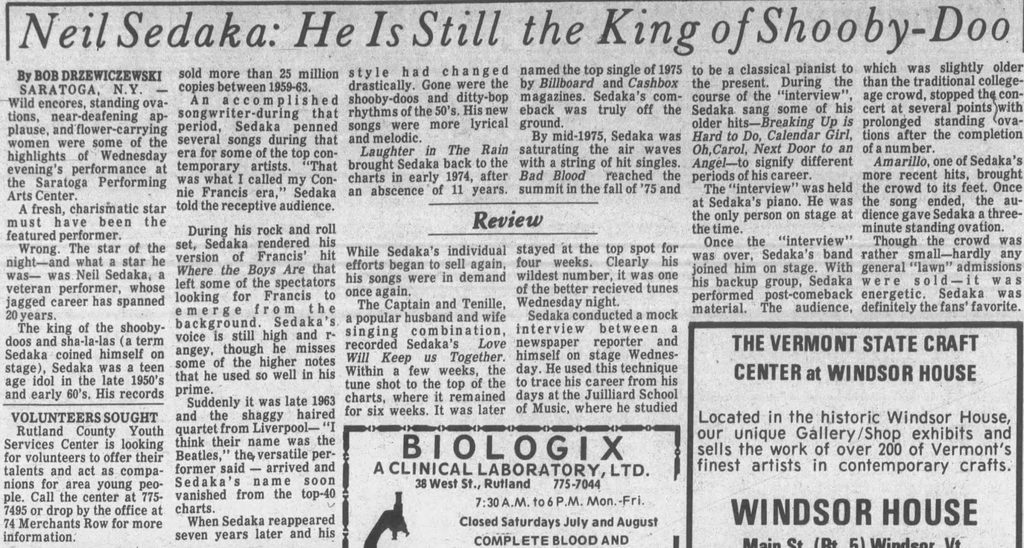
Neil Sedaka: He Is Still the King of Shooby-Doo
by Bob Drzewiczewski, Rutland Daily Herald, September 1, 1978
Wild encores, standing ovations, near-deafening applause, and flower-carrying women were some of the highlights of Wednesday evening’s performance at the Saratoga Performing Arts Center.
A fresh, charismatic star must have been the featured performer.
Wrong. The star of the night—and what a star he was—was Neil Sedaka, a veteran performer, whose jagged career has spanned 20 years.
The king of the shooby-doos and sha-la-las (a term Sedaka coined himself on stage), Sedaka was a teenage idol in the late 1950’s and early 60’s. His records sold more than 25 million copies between 1959-63.
An accomplished songwriter during that period, Sedaka penned several songs during that era for some of the top contemporary artists. “That was what I called my Connie Francis era,” Sedaka told the receptive audience.
During his rock and roll set, Sedaka rendered his version of Francis hit Where the Boys Are that left some of the spectators looking for Francis to emerge from the background. Sedaka’s voice is still high and rangey, though he misses some of the higher notes that he used so well in his prime.
Suddenly it was late 1963 and the shaggy-haired quartet from Liverpool—”I think their name was the Beatles,” the versatile performer said—arrived, and Sedaka’s name soon vanished from the top-40 charts.
When Sedaka reappeared seven years later, his style had changed drastically. Gone were the shooby-doos and ditty-bop rhythms of the 50s. His new songs were more lyrical and melodic.
Laughter in the Rain brought Sedaka back to the charts in early 1974, after an absence of 11 years. While Sedaka’s individual efforts began to sell again, his songs were in demand once again.
The Captain and Tennille, a popular husband-and-wife singing combination, recorded Sedaka’s Love Will Keep Us Together. Within a few weeks, the tune shot to the top of the charts, where it remained for six weeks. It was later named the top single of 1975 by Billboard and Cashbox magazines. Sedaka’s comeback was truly off the ground.
By mid-1975, Sedaka was saturating the airwaves with a string of hit singles. Bad Blood reached the summit in the fall of ’75 and stayed at the top spot for four weeks. Clearly his wildest number, it was one of the better-received tunes Wednesday night.
Sedaka conducted a mock interview between a newspaper reporter and himself on stage Wednesday. He used this technique to trace his career from his days at the Juilliard School of Music, where he studied to be a classical pianist, to the present. During the course of the “interview,” Sedaka sang some of his older hits—Breaking Up is Hard to Do, Calendar Girl, Oh,Carol, Next Door to an Angel—to signify different periods of his career.
The “interview” was held at Sedaka’s piano. He was the only person on stage at the time.
Once the “interview” was over, Sedaka’s band joined him on stage. With his backup group, Sedaka performed post-comeback material. The audience, which was slightly older than the traditional college-age crowd, stopped the concert at several points with prolonged standing ovations after the completion of a number.
Amarillo, one of Sedaka’s more recent hits, brought the crowd to its feet. Once the song ended, the audience gave Sedaka a three-minute standing ovation.
Though the crowd was rather small—hardly any general “lawn” admissions were sold—it was energetic. Sedaka was definitely the fans’ favorite.
Recent Comments