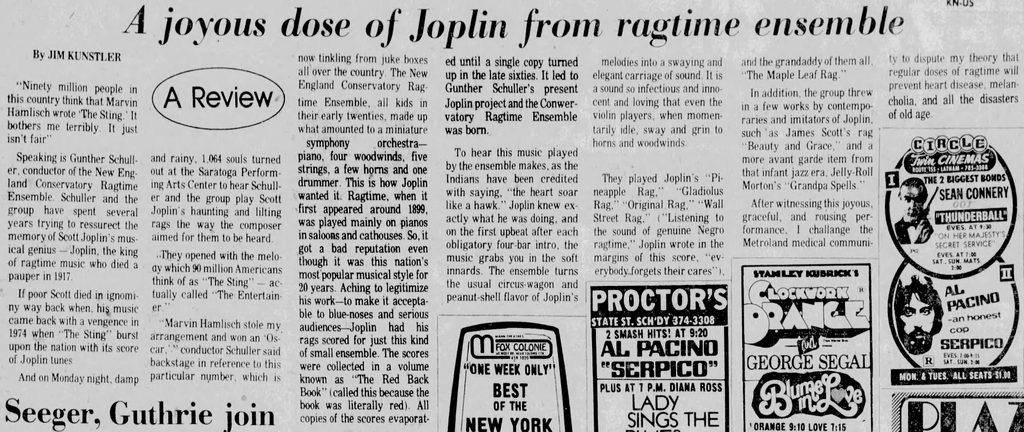
A joyous dose of Joplin from ragtime ensemble
by Jim Kunstler, The Knickerbocker News, June 20, 1974
“Ninety million people in this country think that Marvin Hamlisch wrote ‘The Sting.’ It bothers me terribly. It just isn’t fair.”
Speaking is Gunther Schuller, conductor of the New England Conservatory Ragtime Ensemble. Schuller and the group have spent several years trying to resurrect the memory of Scott Joplin’s musical genius — Joplin, the king of ragtime music who died a pauper in 1917.
If poor Scott died in ignominy way back when, his music came back with a vengeance in 1974 when “The Sting” burst upon the nation with its score of Joplin tunes.
And on Monday night, damp and rainy, 1,064 souls turned out at the Saratoga Performing Arts Center to hear Schuller and the group play Scott Joplin’s haunting and lilting rags the way the composer aimed for them to be heard.
They opened with the melody which 90 million Americans think of as “The Sting” — actually called “The Entertainer.”
Marvin Hamlisch stole my arrangement and won an ‘Oscar’,” conductor Schuller said backstage in reference to this particular number, which is now tinkling from jukeboxes all over the country. The New England Conservatory Ragtime Ensemble, all kids in their early twenties, made up what amounted to a miniature symphony orchestra—piano, four woodwinds, five strings, a few horns and one drummer. This is how Joplin wanted it. Ragtime, when it first appeared around 1899, was played mainly on pianos in saloons and cathouses. So, it got a bad reputation even though it was this nation’s most popular musical style for 20 years. Aching to legitimize his work—to make it acceptable to blue-noses and serious audiences, Joplin had his rags scored for just this kind of small ensemble. The scores were collected in a volume known as “The Red Back Book” (called this because the book was literally red). All copies of the scores evaporated until a single copy turned up in the late sixties. It led to Gunther Schuller’s present Joplin project, and the Conservatory Ragtime Ensemble was born.
To hear this music played by the ensemble makes, as the Indians have been credited with saying, “the heart soar like a hawk.” Joplin knew exactly what he was doing, and on the first upbeat after each obligatory four-bar intro, the music grabs you in the soft innards. The ensemble turns the usual circus-wagon and peanut-shell flavor of Joplin’s melodies into a swaying and elegant carriage of sound. It is a sound so infectious and innocent and loving that even the violin players, when momentarily idle, sway and grin to horns and woodwinds.
They played Joplin’s “Pineapple Rag,” “Gladiolus Rag,” “Original Rag,” “Wall Street Rag.” (“Listening to the sound of genuine Negro ragtime,” Joplin wrote in the margins of this score, “everybody forgets their cares”), and the grandaddy of them all, “The Maple Leaf Rag.”
In addition, the group threw in a few works by contemporaries and imitators of Joplin, such as James Scott’s rag “Beauty and Grace,” and a more avant-garde item from that infant jazz era, Jelly Roll Morton’s “Grandpa Spells.”
After witnessing this joyous, graceful, and rousing performance, I challenge the Metroland medical community to dispute my theory that regular doses of ragtime will prevent heart disease, melancholia, and all the disasters of old age.
Recent Comments