Jazz at Saratoga
by Charles Helman, North Adams Transcript, July 10, 1978
‘It’s catching on’
The bright red tee-shirt made the message as clear as could be. It read JAZZ!, JAZZ!, JAZZ!
The clean-cut young man wearing the shirt was selling cans of soda for 50 cents each to raise money for his admission ticket to the Newport Jazz Festival Saratoga and his transportation from Buffalo, N.Y.
He said his name was Frank and that he attended the State University of New York at Fredonia.
“Disco may be in, but jazz is catching on. It’s better for dancing, and it is much classier.”
As he talked, his foot moved in rhythm to the sounds of the Harry James Big Band.
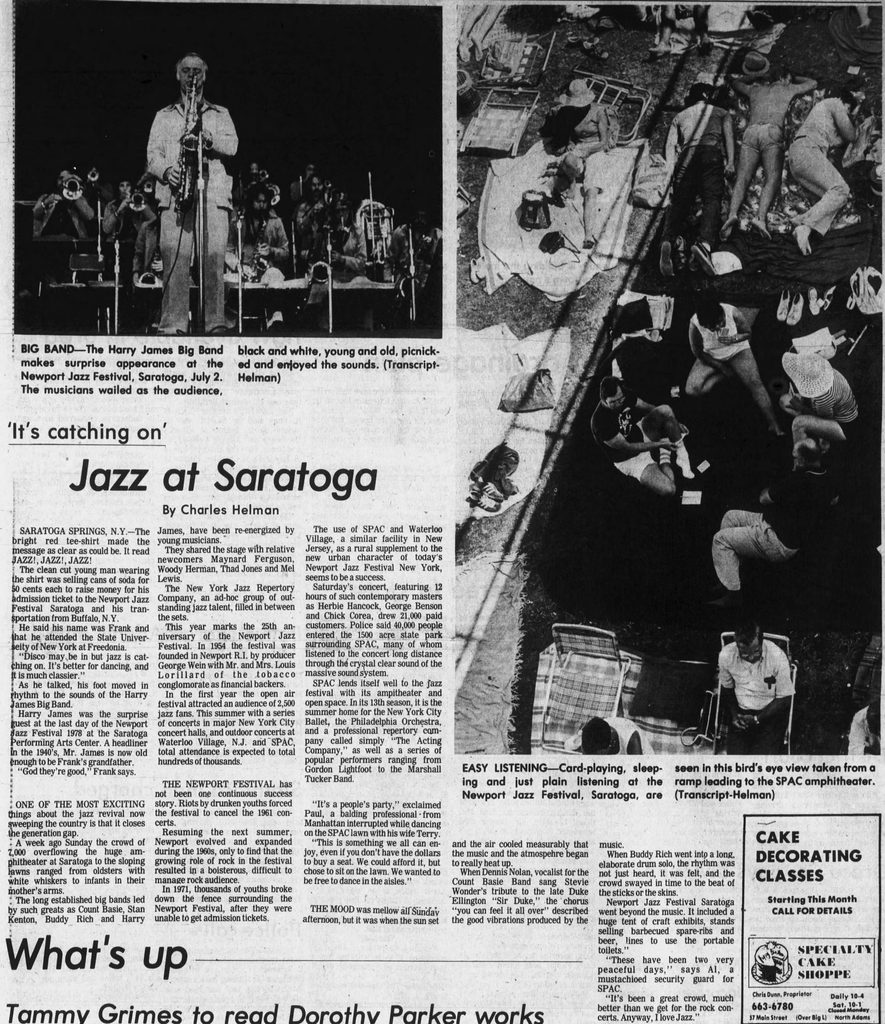
Harry James was the surprise guest at the last day of the Newport Jazz Festival 1978 at the Saratoga Performing Arts Center. A headliner in the 1940’s, Mr. James is now old enough to be Frank’s grandfather.
“God, they’re good,” Frank says.
ONE OF THE MOST EXCITING things about the jazz revival now sweeping the country is that it closes the generation gap.
A week ago Sunday the crowd of 2,000 overflowing the huge amphitheater at Saratoga to the sloping lawns ranged from oldsters with white whiskers to infants in their mother’s arms.
The long-established big bands led by such greats as Count Basie, Stan Kenton, Buddy Rich and Harry James, have been reenergized by young musicians.
They shared the stage with relative newcomers Maynard Ferguson, Woody Herman, Thad Jones and Mel Lewis.
The New York Jazz Repertory Company, an ad hoc group of outstanding jazz talent, filled in between the sets.
This year marks the 25th anniversary of the Newport Jazz Festival. In 1954, the festival was founded in Newport, R.I., by producer George Wein with Mr. and Mrs. Louis Lorillard of the tobacco conglomerate as financial backers.
In the first year, the open-air festival attracted an audience of 2,500 jazz fans. This summer, with a series of concerts in major New York City concert halls, and outdoor concerts at Waterloo Village, N.J. and SPAC, total attendance is expected to total hundreds of thousands.
THE NEWPORT FESTIVAL has not been one continuous success story. Riots by drunken youths forced the festival to cancel the 1961 concerts.
Resuming the next summer, Newport evolved and expanded during the 1960s, only to find that the growing role of rock in the festival resulted in a boisterous, difficult-to-manage rock audience.
In 1971, thousands of youths broke down the fence surrounding the Newport Festival after they were unable to get admission tickets.
The use of SPAC and Waterloo Village, a similar facility in New Jersey, as a rural supplement to the new urban character of today’s Newport Jazz Festival New York, seems to be a success.
Saturday’s concert, featuring 12 hours of such contemporary masters as Herbie Hancock, George Benson and Chick Corea, drew 21,000 paid customers. Police said 40,000 people entered the 1500 acre state park surrounding SPAC, many of whom listened to the concert long-distance through the crystal-clear sound of the massive sound system.
SPAC lends itself well to the Jazz festival with its amphitheater and open space. In its 13th season, it is the summer home for the New York City Ballet, the Philadelphia Orchestra, and a professional repertory company called simply “The Acting Company,” as well as a series of popular performers ranging from Gordon Lightfoot to the Marshall Tucker Band
“It’s a people’s party,” exclaimed Paul, a balding professional from Manhattan, interrupted while dancing on the SPAC lawn with his wife Terry.
*This is something we all can enjoy, even if you don’t have the dollars to buy a seat. We could afford it, but chose to sit on the lawn. We wanted to be free to dance in the aisles.”
THE MOOD was mellow all Sunday afternoon, but it was when the sun set and the air cooled measurably that the music and the atmosphere began to really heat up.
When Dennis Rowland, vocalist for the Count Basie Band, sang Stevie Wonder’s tribute to the late Duke Ellington, “Sir Duke,” the chorus “you can feel it all over” described the good vibrations produced by the music.
When Buddy Rich went into a long, elaborate drum solo, the rhythm was not just heard; it was felt, and the crowd swayed in time to the beat of the sticks on the skins.
Newport Jazz Festival Saratoga went beyond the music. It included a huge tent of craft exhibits, stands selling barbecued spare ribs and beer, lines to use the portable toilets.
*These have been two very peaceful days,” says Al, a mustachioed security guard for SPAC.
“It’s been a great crowd, much better than we get for the rock concerts. Anyway, I love Jazz.”
Recent Comments