(editor’s note – no ex post facto proof of Elvin Jones)
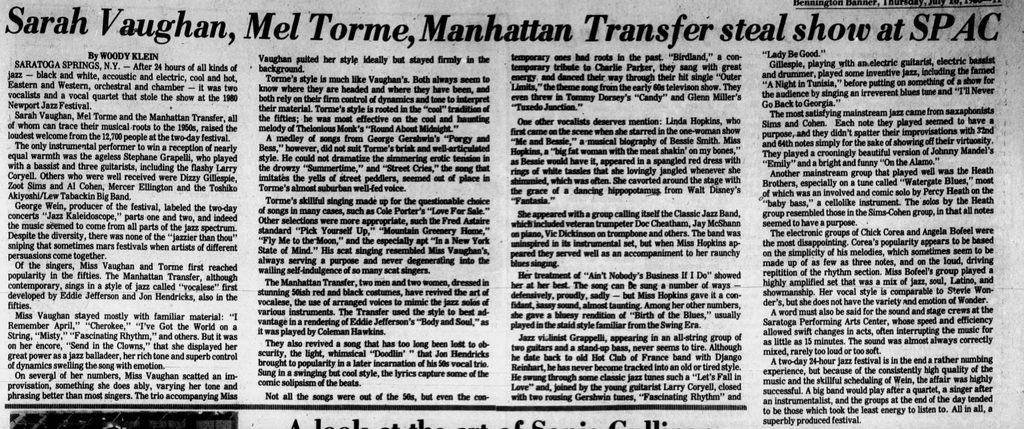
Sarah Vaughan, Mel Torme, Manhattan Transfer steal show at SPAC
by Woody Klein, Bennington Banner, July 10, 1980
After 24 hours of all kinds of jazz — black and white, acoustic and electric, cool and hot, Eastern and Western, orchestral and chamber — it was two vocalists and a vocal quartet that stole the show at the 1980 Newport Jazz Festival.
Sarah Vaughan, Mel Torme and the Manhattan Transfer, all of whom can trace their musical roots to the 1950s, raised the loudest welcome from the 12,700 people at the two-day festival.
The only instrumental performer to win a reception of nearly equal warmth was the ageless Stephane Grapelli, who played with a bassist and three guitarists, including the flashy Larry Coryell. Others who were well received were Dizzy Gillespie, Zoot Sims and Al Cohen, Mercer Ellington and the Toshiko Akiyoshi/Lew Tabackin Big Band.
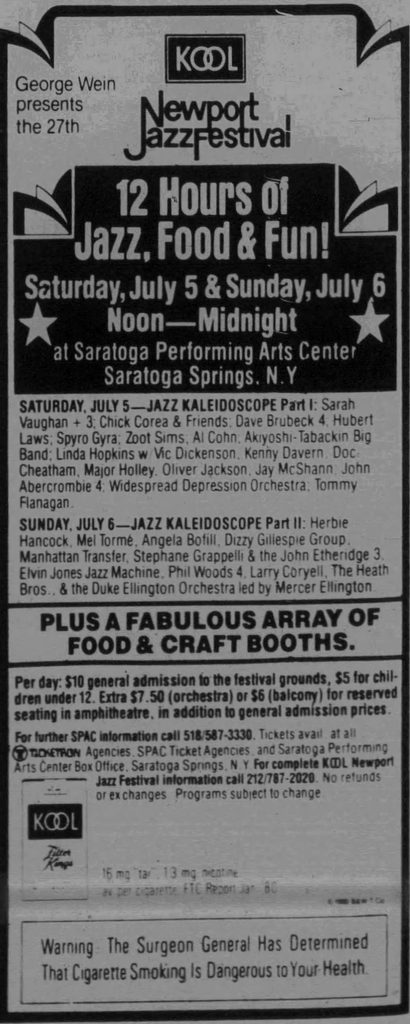
George Wein, producer of the festival, labeled the two-day concerts “Jazz Kaleidoscope,” parts one and two, and indeed the music seemed to come from all parts of the jazz spectrum. Despite the diversity, there was none of the “jazzier than thou” sniping that sometimes mars festivals when artists of different persuasions come together.
Of the singers, Miss Vaughan and Torme first reached popularity in the fifties. The Manhattan Transfer, although contemporary, sings in a style of jazz called “vocalese” first developed by Eddie Jefferson and Jon Hendricks, also in the fifties.
Miss Vaughan stayed mostly with familiar material: “I Remember April,” “Cherokee,” “I’ve Got the World on a String,” “Misty,” “Fascinating Rhythm,” and others. But it was on her encore, “Send in the Clowns,” that she displayed her great power as a jazz balladeer, her rich tone and superb control of dynamics swelling the song with emotion.
On several of her numbers, Miss Vaughan scatted an improvisation, something she does ably, varying her tone and phrasing better than most singers. The trio accompanying Miss Vaughan suited her style ideally but stayed firmly in the background.
Torme’s style is much like Vaughan’s. Both always seem to know where they are headed and where they have been, and both rely on their firm control of dynamics and tone to interpret their material. Torme’s style is rooted in the “cool” tradition of the fifties; he was most effective on the cool and haunting melody of Thelonious Monk’s “Round About Midnight.”
A medley of songs from George Gershwin’s “Porgy and Bess,” however, did not suit Torme’s brisk and well-articulated style. He could not dramatize the simmering erotic tension in the drowsy “Summertime,” and “Street Cries,” the song that imitates the yells of street peddlers, seemed out of place in Torme’s almost suburban well-fed voice.
Torme’s skillful singing made up for the questionable choice of songs in many cases, such as Cole Porter’s “Love For Sale.” Other selections were more appropriate, such as the Fred Astaire standard “Pick Yourself Up,” “Mountain Greenery Home,” “Fly Me to the Moon,” and the especially apt “In a New York State of Mind.” His scat singing resembled Miss Vaughan’s, always serving a purpose and never degenerating into the wailing self-indulgence of so many scat singers.
The Manhattan Transfer, two men and two women, dressed in stunning 50ish red and black costumes, have revived the art of vocalese, the use of arranged voices to mimic the jazz solos of various instruments. The Transfer used the style to best advantage in a rendering of Eddie Jefferson’s “Body and Soul,” as it was played by Coleman Hawkins.
They also revived a song that has too long been lost to obscurity, the light, whimsical “Doodlin’” that Jon Hendricks brought to popularity in a later incarnation of his 50s vocal trio. Sung in a swinging but cool style, the lyrics capture some of the comic solipsism of the beats.
Not all the songs were out of the 50s, but even the contemporary ones had roots in the past. “Birdland,” a contemporary tribute to Charlie Parker, they sang with great energy, and danced their way through their hit single “Outer Limits,” the theme song from the earlý 60s television show. They even threw in Tommy Dorsey’s “Candy” and Glenn Miller’s “Tuxedo Junction.”
One other vocalist deserves mention: Linda Hopkins, who first came on the scene when she starred in the one-woman show “Me and Bessie,” a musical biography of Bessie Smith. Miss Hopkins, a “big fat woman with the meat shakin’ on my bones,” as Bessie would have it, appeared in a spangled red dress with rings of white tassels that she lovingly jangled whenever she shimmied, which was often. She cavorted around the stage with the grace of a dancing hippopotamuş, from Walt Disney’s “Fantasia.”
She appeared with a group calling itself the Classic Jazz Band, which included veteran trumpeter Doc Cheatham, Jay McShann on piano, Vic Dickinson on trombone, and others. The band was uninspired in its instrumental set, but when Miss Hopkins appeared they served well as an accompaniment to her raunchy blues singing.
Her treatment of “Ain’t Nobody’s Business If I Do” showed her at her best. The song can be sung a number of ways — defensively, proudly, sadly — but Miss Hopkins gave it a confident, sassy sound, almost taunting. Among her other numbers, she gave a bluesy rendition of “Birth of the Blues,” usually played in the staid style familiar from the Swing Era.
Jazz violinist Grappelli, appearing in an all-string group of two guitars and a stand-up bass, never seems to tire. Although he dates back to the old Hot Club of France band with Django Reinhardt, he has never become tracked into an old or tired style. He swung through some classic jazz tunes such as “Let’s Fall in Love” and, joined by the young guitarist Larry Coryell, closed with two rousing Gershwin tunes, “Fascinating Rhythm” and “Lady Be Good.”
Gillespie, playing with an electric guitarist, electric bassist and drummer, played some inventive jazz, including the famed “A Night in Tunisia,” before putting on something of a show for the audience by singing an irreverent blues tune and “I’ll Never Go Back to Georgia.”
The most satisfying mainstream jazz came from saxophonists Sims and Cohen. Each note they played seemed to have a purpose, and they didn’t spatter their improvisations with 32nd and 64th notes simply for the sake of showing off their virtuosity. They played a crooningly beautiful version of Johnny Mandel’s “Emily” and a bright and funny “On the Alamo.”
Another mainstream group that played well was the Heath Brothers, especially on a tune called “Watergate Blues,” most of which was an involved and comic solo by Percy Heath on the “baby bass,” a cello-like instrument. The solos by the Heath group resembled those in the Sims-Cohen group, in that all notes seemed to have a purpose.
The electronic groups of Chick Corea and Angela Bofill were the most disappointing. Corea’s popularity appears to be based on the simplicity of his melodies, which sometimes seem to be made up of as few as three notes, and on the loud, driving repetition of the rhythm section. Miss Bofill’s group played a highly amplified set that was a mix of jazz, soul, Latino, and showmanship. Her vocal style is comparable to Stevie Wonder’s, but she does not have the variety and emotion of Wonder.
A word must also be said for the sound and stage crews at the Saratoga Performing Arts Center, whose speed and efficiency allowed swift changes in acts, often interrupting the music for as little as 15 minutes. The sound was almost always correctly mixed, rarely too loud or too soft.
A two-day 24-hour jazz festival is in the end a rather numbing experience, but because of the consistently high quality of the music and the skillful scheduling of Wein, the affair was highly successful. A big band would play after a quartet, a singer after an instrumentalist, and the groups at the end of the day tended
The Post-Star, July 3, 1980
Recent Comments