(editor’s note – no ex post facto proof for Fats Domino or Dom Salvadore. Jimmy Witherspoon may have replaced Fats Domino on the bill, but not confirmed.)
Newport Jazz Festival: great performances by everyone
by Phil West, The Stylus, July 11, 1979
This past weekend, upstate New York music lovers were treated to a very special happening. At the Performing Arts Center in Saratoga Springs, NY, those who attended had an exciting two days of the best jazz played anywhere in the world today.
George Wein brought his baby, The Newport Jazz Festival, to Saratoga Springs for the second consecutive time in its 26-year history. The music started right on schedule, at noon, and there was easy access to anyone who wanted to get in. The intermittent rain throughout the day was more than compensated for by the beauty of the grounds that were open to all who bought tickets.
The first few bands, although not as famous as some of the other performers, set a high standard for the music to come. The Charlie Rouse Trio opened the show with some easy listening jazz, and a Latin band named Machito followed with some high-energy Spanish Jazz.
What really started the audience up was the next session, which featured Art Blakey and his trio playing the rhythm section for the “battle of the saxes”. This was the stupendous combination of Eddie “Lockjaw” Davis, Johnny Griffin, and “Illinois” Jacquet.
Lonnie Liston Smith followed with his honey-dipped set, and then Carmen McRae took the stage and started on a vocal performance that would have made Ella proud. She did a varied set, ranging from gutsy Billie Holiday to a heavenly sweet version of Mark-Almond’s “New York State of Mind.”
Festival atmosphere
One thing that made this festival even more enjoyable was the fact that there was so much open space that a huge crafts tent was raised. Jewelers and sculptors, candle-makers and dulcimer-makers, leather workers and woodworkers were all in attendance.
The staging of the event was probably the most efficient operation ever witnessed at a musical event. Even with big bands of 15 people, the set change never took longer than ten or fifteen minutes.
After Dave Brubeck’s phenomenal set, the audience went Santa Cruisin’ with Grover Washington Jr. and his fusion ensemble. The band was as tight as any seen, and the electronic music was a nice way to get the sun down. To cry its loss, the great blues singer Jimmy Witherspoon took the stage. He got everyone anticipating the highlight of the evening when he sang the insert-anywhere blues verse, “I’d rather drink Muddy Water Than Sleep in a Hollow
Log.” Not 15 minutes later, the Muddy Waters Band strode on stage to a huge ovation. The band did a three-tune warm-up before Muddy himself took the stage. When he finally did place his stool in front of the downstage center mike reserved for him, sparks flew. He did a few songs, including “Baby Please Don’t Go.”
After a few more, Muddy complained he couldn’t handle it alone, and he needed some help.
Surprise guest and inspiration
If you had to judge by the way he staggered on stage, you wouldn’t think this guy could be much help, but when Johnny Winter picked up that massive Destroyer and started to play, the fire finally started.
The late gig they had both played the night before in New York City took its toll, but it was a rare taste of a blues master playing with the man who inspired him.
Sunday, the music got underway with Willie Bobo and Bobo. Don’t be misled by the name; they really are good. Willie Bobo himself is a fine male vocalist with a mainly original set. The one notable exception was a sweet rendering of George Gerswhin’s “Summertime”.
Next, Gerry Mulligan, the great tenor and baritone player, performed the longest set of the weekend—he played for an hour and a half. Even though Mulligan was a superb act, Betty Carter followed and didn’t let the crowd down. She had a lot of help from her sidemen (bassist Jimmy Washington and pianist John Harris).
Next came the most enjoyable set of the weekend—B.B. King. His guitar work, still incomparable, complemented his ever-strong voice. His band was a bit large, with ten musicians and an on-stage horn arranger, Phil Blackman. After King, the rest of any other show might have been a letdown, but not this one.
Jamming Session
Veteran Newport performer Hubert Laws’ younger brother, Ronnie, and his fusion band called Pressure used an interesting combination of sounds to keep the audience until the Newport All-Star Jam, which was to follow. This was billed as the highlight of the festival, and featured such talent as Dizzy Gillespie, Hubert Laws, George Benson, Roland Hanna, Freddie Hubbard and others, some of whom played during other parts of the festival.
The jamming was a bit cluttered and somewhat disorganized. The lack of cohesiveness might be explained through the phenomenon of a dozen stars sharing the spotlight that each one is used to having for his very own.
Those few who stayed till the end were not sent home disappointed. The Lionel Hampton (vibes, drums) Big Band was one of the best sets of the weekend.
The two-day celebration was a fitting tribute to live music that is still really alive. I hope they go on forever.
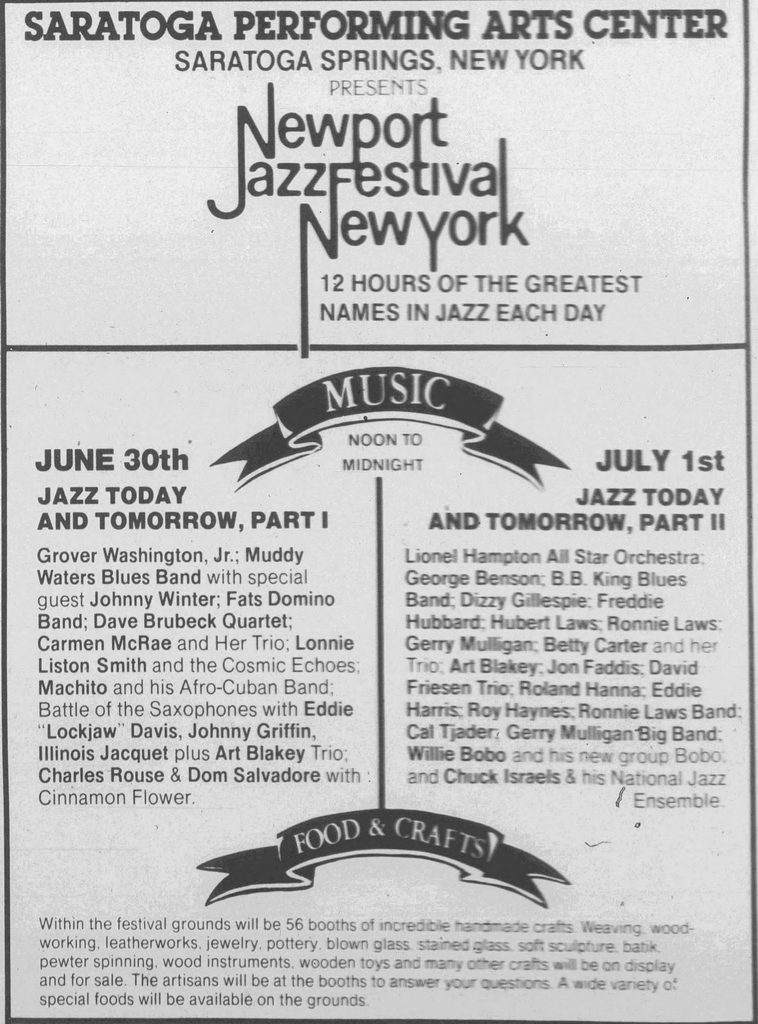
The Berkshire Eagle, June 28, 1979
Recent Comments