SPAC evening wasn’t too jazzy
by Bill Brina, The Knickerbocker News, July 3, 1976
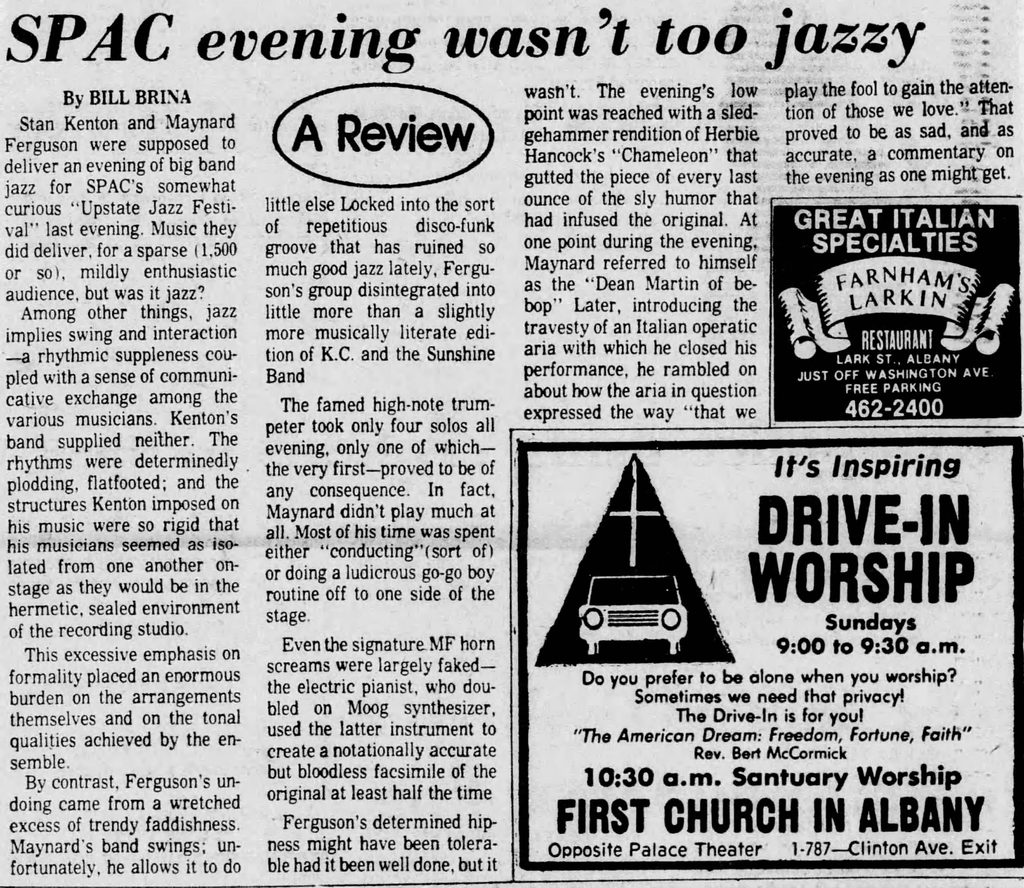
Stan Kenton and Maynard Ferguson were supposed to deliver an evening of big band jazz for SPAC’s somewhat curious “Upstate Jazz Festival” last evening. Music they did deliver, for a sparse (1,500 or so), mildly enthusiastic audience, but was it jazz?
Among other things, jazz implies swing and interaction—a rhythmic suppleness coupled with a sense of communicative exchange among the various musicians. Kenton’s band supplied neither. The rhythms were determinedly plodding, flat-footed, and the structures Kenton imposed on his music were so rigid that his musicians seemed as isolated from one another onstage as they would be in the hermetic, sealed environment of the recording studio.
This excessive emphasis on formality placed an enormous burden on the arrangements themselves and on the tonal qualities achieved by the ensemble.
By contrast, Ferguson’s undoing came from a wretched excess of trendy faddishness. Maynard’s band swings; unfortunately, he allows it to do little else. Locked into the sort of repetitious disco-funk groove that has ruined so much good jazz lately, Ferguson’s group disintegrated into little more than a slightly more musically literate edition of K.C. and the Sunshine Band.
The famed high-note trumpeter took only four solos all evening, only one of which—the very first—proved to be of any consequence. In fact, Maynard didn’t play much at all. Most of his time was spent either “conducting” (sort of) or doing a ludicrous go-go boy routine off to one side of the stage.
Even the signature MF horn screams were largely faked—the electric pianist, who doubled on Moog synthesizer, used the latter instrument to create a notationally accurate but bloodless facsimile of the original at least half the time.
Ferguson’s determined hipness might have been tolerable had it been well done, but it wasn’t. The evening’s low point was reached with a sledgehammer rendition of Herbie Hancock’s “Chameleon” that gutted the piece of every last ounce of the sly humor that had infused the original. At one point during the evening, Maynard referred to himself as the “Dean Martin of be-bop.” Later, introducing the travesty of an Italian operatic aria with which he closed his performance, he rambled on about how the aria in question expressed the way “that we play the fool to gain the attention of those we love.” That proved to be as sad, and as accurate, a commentary on the evening as one might get.
Recent Comments