(editor’s note – no ex post facto proof for Edgar Winter. This date was originally scheduled for David Crosby and Graham Nash, but this was canceled.)
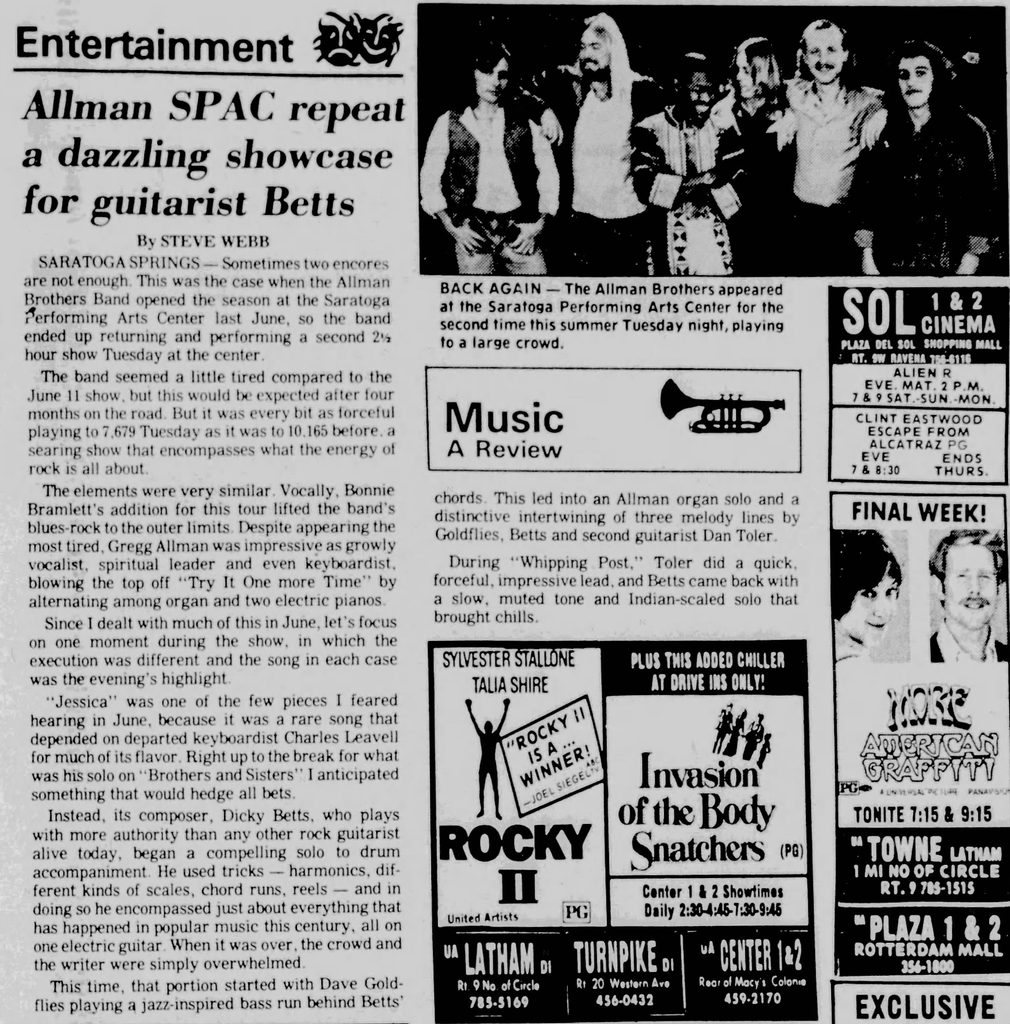
Allman SPAC repeat a dazzling showcase for guitarist Betts
by Steve Webb, The Knickerbocker News, July 25, 1979
Sometimes two encores are not enough. This was the case when the Allman Brothers Band opened the season at the Saratoga Performing Arts Center last June, so the band ended up returning and performing a second 2 1/2 hour show Tuesday at the center.
The band seemed a little tired compared to the June 11 show, but this would be expected after four months on the road. But it was every bit as forceful playing to 7,679 Tuesday as it was to 10,165 before, a searing show that encompasses what the energy of rock is all about.
The elements were very similar. Vocally, Bonnie Bramlett’s addition for this tour lifted the band’s blues-rock to the outer limits. Despite appearing the most tired, Gregg Allman was impressive as growly vocalist, spiritual leader, and even keyboardist, blowing the top off “Try It One More Time” by alternating among organ and two electric pianos.
Since I dealt with much of this in June, let’s focus on one moment during the show, in which the execution was different, and the song in each case was the evening’s highlight.
“Jessica” was one of the few pieces I feared hearing in June, because it was a rare song that depended on departed keyboardist Charles Leavell for much of its flavor. Right up to the break for what was his solo on “Brothers and Sisters,” I anticipated something that would hedge all bets.
Instead, its composer, Dickey Betts, who plays with more authority than any other rock guitarist alive today, began a compelling solo to drum accompaniment. He used tricks – harmonies, different kinds of scales, chord runs, reels — and in doing so he encompassed just about everything that has happened in popular music this century, all on one electric guitar. When it was over, the crowd and the writer were simply overwhelmed.
This time, that portion started with Dave Goldflies playing a jazz-inspired bass run behind Betts’ chords. This led into an Allman organ solo and a distinctive intertwining of three melody lines by Goldflies, Betts and second guitarist Dan Toler.
During “Whipping Post,” Toler did a quick, forceful, impressive lead, and Betts came back with a slow, muted tone and Indian-scaled solo that brought chills.
The Post-Star, August 28, 1979
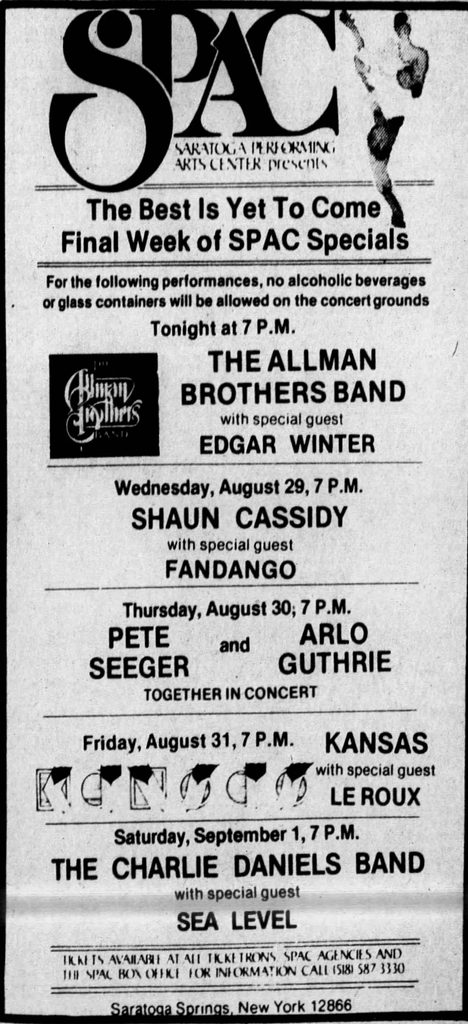
The Post-Star, April 18, 1979
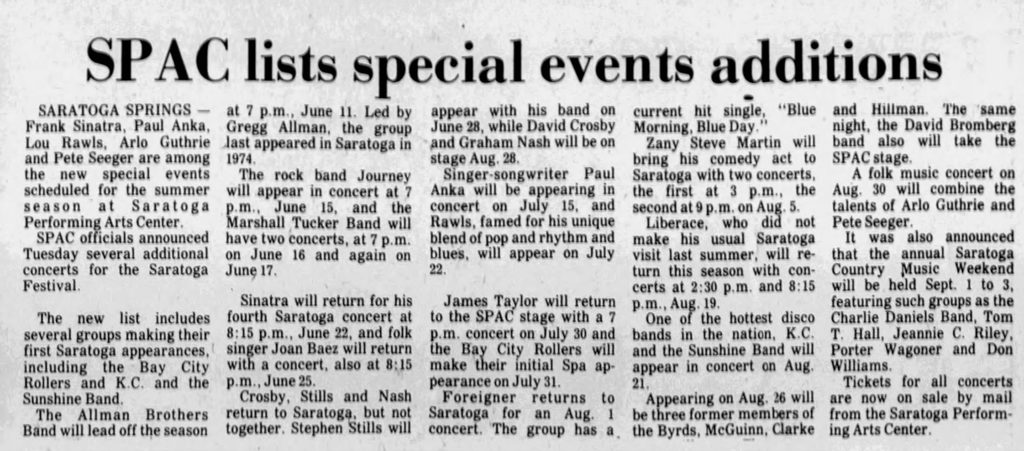
Recent Comments