Petty delivers spirited rock to hot, excited Spa crowd
by Steve Webb, The Knickerbocker News, June 16, 1980
It was the Saratoga Performing Arts Center’s first big show of the summer. For the first time in almost two weeks of concerts, the audience on the lawns overflowed from the slope outside the amphitheater onto level ground.
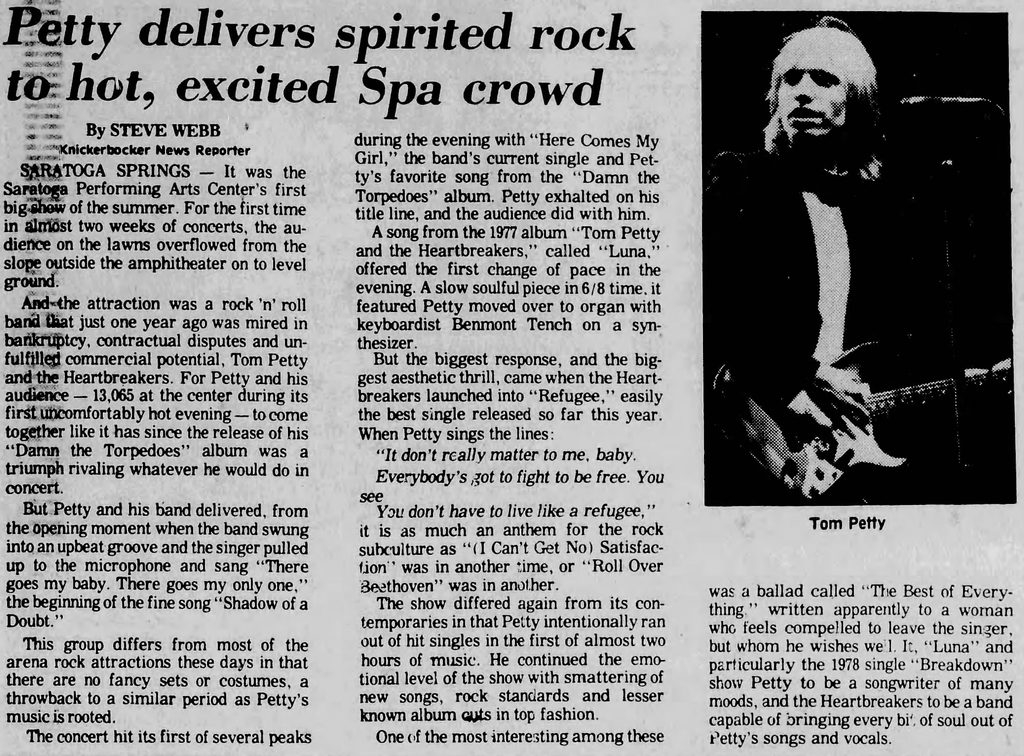
And the attraction was a rock ‘n’ roll band that just one year ago was mired in bankruptcy, contractual disputes and unfulfilled commercial potential, Tom Petty and the Heartbreakers. For Petty and his audience — 13,065 at the center during its first uncomfortably hot evening — to come together like it has since the release of his “Damn the Torpedoes” album was a triumph rivaling whatever he would do in concert.
But Petty and his band delivered, from the opening moment when the band swung into an upbeat groove, and the singer pulled up to the microphone and sang “There goes my baby. There goes my only one,” the beginning of the fine song “Shadow of a Doubt.”
This group differs from most of the arena rock attractions these days in that there are no fancy sets or costumes, a throwback to a similar period as Petty’s music is rooted.
The concert hit its first of several peaks during the evening with “Here Comes My Girl,” the band’s current single and Petty’s favorite song from the “Damn the Torpedoes” album. Petty exhalted on his title line, and the audience did with him.
A song from the 1977 album “Tom Petty and the Heartbreakers,” called “Luna,” offered the first change of pace in the evening. A slow, soulful piece in 6/8 time, it featured Petty moved over to organ with keyboardist Benmont Tench on a synthesizer.
But the biggest response, and the biggest aesthetic thrill, came when the Heartbreakers launched into “Refugee,” easily the best single released so far this year. When Petty sings the lines:
“It don’t really matter to me, baby.
Everybody’s got to fight to be free. You see
You don’t have to live like a refugee,”
it is as much an anthem for the rock subculture as “(I Can’t Get No) Satisfaction was in another time, or “Roll Over Beethoven” was in another.
The show differed again from its contemporaries in that Petty intentionally ran out of hit singles in the first of almost two hours of music. He continued the emotional level of the show with a smattering of new songs, rock standards and lesser-known album cuts in top fashion.
One of the most interesting among these was a ballad called “The Best of Everything ” written apparently to a woman who feels compelled to leave the singer, but whom he wishes well. It, “Luna,” and particularly the 1978 single “Breakdown,” show Petty to be a songwriter of many moods, and the Heartbreakers to be a band capable of bringing every bit of soul out of Petty’s songs and vocals.
Recent Comments