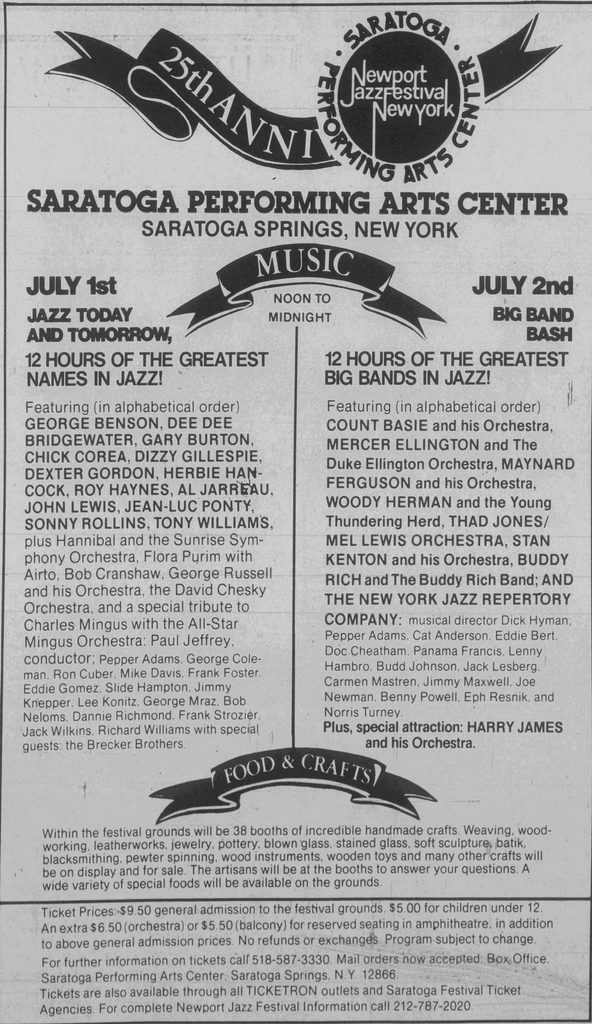
(editor’s note – no ex post facto proof for Pepper Adams, Eddie Bert, Doc Cheatham, Panama Francis, Lenny Hambro, Budd Johnson, Jack Lesberg, Carmen Mastren, Jimmy Maxwell, Joe Newman, Benny Powell, or Ephie Resnick)
SPAC’s 2 Newport marathons chronicle the evolution of jazz
by Matthew Maguire, The Knickerbocker News, July 3, 1978
The jazz stars of yesterday and today took their turns on the stage of the Saratoga Performing Arts Center this weekend in two 12-hour marathons that marked the beginning of a new era in the 25-year-old Newport Jazz Festival and perhaps the greatest moment in Metroland’s jazz history.
It was an experimental two-day segment of the festival conducted at SPAC. From all accounts, it succeeded.
Sunday’s session, featuring virtually all the great big bands in jazz history, could have served as an “Intro to Jazz” college course. The stars of yesterday, today and tomorrow provided a concise musical history of the evolution of jazz as well as some hints on its future course.
Every big name band imaginable was represented: Woody Herman, Mercer Ellington, Stan Kenton, Harry James, Count Basie, Maynard Ferguson and Thad Jones-Mel Lewis.
Every aspect of jazz life was documented – the loose atmosphere, the competition among players, and the improvisational brilliance.
Most of these bands, it should be noted, follow similar patterns in their makeup. All are led by established stars who perform to varying extents. In almost all cases, the band includes one or two established soloists. The remainder of players are college-trained standouts who lack only experience.
Buddy Rich and Woody Herman, for instance, carry established stars Steve Marcus and Frank Tiberi on first saxophone and complement them with younger players.
This setup is important to jazz because it mingles the stars of yesterday and today with the hope for the future. More than a few of today’s stars paid dues in such big bands, and it’s a proven method for cultivating talent.
The New York City Jazz Repertory Company orchestra, by far the most talent-laden unit to perform, began the session under what could have been disastrous circumstances: All their music had been left in New York City.
So, instead of concise charts intended to recreate great moments in jazz, they played three open-ended jams, each played without rehearsal.
But “Saratoga Clambake,” “Hot Springs Blues” and “Spur of the Moment” still proved worthwhile listening.
Even in such unstructured jams, the talent in this band could not be denied. Cat Anderson stunned the audience with his high-note fluency, and fellow Ellington alumnus Norris Turney on alto saxophone also excelled.
Their jams reaffirmed the essentially improvisational nature of jazz.
The bands of Woody Herman, Stan Kenton, Mercer Ellington, Buddy Rich, Count Basie and Thad Jones-Mel Lewis offered their usual fares with expected quality. Each was well received.
Singling out highlights is difficult, since each band merits a full review in itself. Quickly, though:
There were several good drum solos. Sonny Payne, a charismatic percussionist currently with Harry James, stole the show with his drumming and stick-juggling. Buddy Rich followed with one of his usual displays of technique and endurance — only to be surpassed by Butch Miles of Basie’s band in quality if not duration.
There was excellent singing. Particularly noteworthy was the work of Dennis Rowland, a handsome young performer with Count Basie. He handled standards and recent pop selections smoothly, with a range easily making him worthy of comparison to Jimmy Rushing and Joe Williams.
The best-received bands, it is interesting to note, were Harry James’ and Maynard Ferguson’s – which says something about the wide-reaching popularity of the idiom. James, by far the most conservative stylist present, captured the audience with energetic renditions of standards. Ferguson, the modernist, showed surprising taste in his use of electronic equipment. Echo gadgets and the synthesizer were employed to enhance an already good product, not to disguise a lack of substance.
The Newport Jazz Festival is the oldest jazz festival in the country and perhaps the most prestigious in the world. One can only hope it returns next year. Having a chunk of it in Metroland is almost too good to be true.
The Berkshire Eagle, June 26, 1978
Recent Comments