Two-day Newport Festival at SPAC is a smashing success
by Kyle Hughes, Bennington Banner, July 5, 1978
The day before the Newport Jazz Festival marathon began last Saturday, a still-live pipe bomb was discovered by a Saratoga Performing Arts Center ground crew cleaning up a parking lot.
It was taken to a dump nearby and exploded.
With the discovery coming as it did on the heels of a performance by the rock group Kansas that was mostly noteworthy for the amount of fireworks detonated (including reports of heavy-duty road flares being brandished), SPAC officials might have had cause to feel uneasy about the large crowds that were expected to show up Saturday for the first 13-hour concert of the Newport Jazz Festival in Saratoga.
But everything went smoothly, and SPAC spokesmen variously estimated between 20,000 and 40,000 jazz fans attended the festival that day. It was the first time the prestigious Newport Jazz Festival was held at the center and it was a rousing success.
Sunday’s concert, while not boasting such a large attendance, was equally successful.
The biggest inconvenience at Saturday’s festivities was what seemed like an unnecessarily long delay before Chick Corea came out on stage.
He was probably the headline attraction in the mind of many fans there, and once he did appear, he played a tight if impersonal set. Corea got a tumultuous reception from the crowd, but a spectator not enamoured by his particular jazz-rock fusion of styles might have wondered what all the fuss was about.
The 23th Newport Jazz Festival, mostly held in the five boroughs of New York, was originally planned to take place completely at Saratoga. Instead, SPAC hosted two long days of music, with the majority of the festival taking place in New York City.
Saturday’s show featured Dizzy Gillespie, Airto, Sonny Rollins, Larry Coryell, Jean-Luc Ponty, Dexter Gordon, George Benson, Gary Burton, Herbie Hancock, George Russell, Al Jarreau, John Lewis, Tony Williams, an all-star orchestra made up of former Charles Mingus sidemen, Pepper Adams, Flora Purim, Dee Dee Bridgewater and a host of others.
If that wasn’t enough to sate the most voracious musical appetite, Sunday was “Saratoga Swing—A12-Hour Big Band Bash.”
Count Basie. Mercer Ellington and the Ellington Orchestra, Woody Herman, Buddy Rich, Maynard Ferguson, Thad Jones and Mel Lewis, Stan Kenton, the New York Jazz Repertory Company and others took to the stage Sunday.
A listener encamped on the spacious grounds of the outdoor center wandered out a little dazed and enervated after the 12- or 13-hour indulgence. But Saratoga Springs is the kind of place in the summer that bursts with activity until 4 or 5 in the morning, and few people went directly home to rest up for the next day.
A newly opened jazz bar, 17 Maple Avenue, featured well- known reedman Nick Brignola and friends, and Newport refugees packed the club until a few hours before the sun came up.
The main musical action that weekend, however, remained at SPAC.
Everyone at the festival left each day with his or her own favorites out of the variety of different performers.
Chick Corea and the other rock-tinged jazz crossover groups were big favorites with the crowd; not incidentally, they probably sell more records than most of the older mainstream artists.
Corea, Herbie Hancock and George Benson fall into the rock category both in their recent pop-music artist incarnations and their fantastic commercial success. Even the harshest critics of jazz-rock fusion music will admit they are musicians who have paid their dues—and have entered a higher tax bracket.
Complaints about adulteration of musical styles usually don’t matter to the people who like the music anyway, and the plain relaxed pleasure of hearing so much great music over a summer weekend finally diminished any personal quarrels over an artist’s current direction.
It is perhaps easiest just to list some of the stand-outs of the two-day festival’s full measure of music.
For a mainstream jazz fan, one of the events of great interest Saturday was surely the virtually all-star tribute to Charles Mingus—featuring many of his illustrious ex-sidemen. Pepper Adams, Larry Coryell, Lee Konitz, Slide Hampton, the Brecker brothers, and Eddie Gomez were only a few members of the orchestra, which performed several of Mingus’ compositions.
The 20-odd-piece orchestra was a highlight of the show, and Mingus’ music was arranged and performed enthusiastically.
Brazilian vocalist Flora Purim, currently in the process of being deported back to her native country because of drug hassles with the US. government, performed a dynamic Latin set with percussionist Airto (pronounced, he told the crowd, eye-EAR-toe).
Chick Corea performed a beautiful, understated duet with Gary Burton on vibes, with both of them abandoning the stage too soon so that Corea’s mountain of speakers and electronic equipment could be assembled.
Corea returned an hour or so later with a 13-piece ensemble whose eclectic sound ranged from a hard synthesised funk to a bombastically arranged string section. While the tunes were repetitive to someone who was unfamiliar with his records (and he plugged them between each number), all the performances were good, and in Corea’s case, a virtuoso turn.
Herbie Hancock suddenly appeared on stage at one point and engaged in a dynamic keyboard dialogue with Corea. Both, like many others on today’s fusion jazz scene, are veterans of Miles Davis’ breakthrough groups of the late
’60s and early ’70s.
Composer and teacher George Russell played with his orchestra and even shouted some bop poetry about New
York City.
Saturday night ended at SPAC with an all-star jam. Dizzy Gillespie, Herbie Hancock, Larry Coryell, Roy Haynes, Tony Williams, George Benson, Randy and Mike Brecker, Dexter Gordon, Jean-Luc Ponty, Sonny Rollins, and vocalists Al Jarreau and Dee Dee Bridgewater were all center stage for one last jam.
“I don’t know what’s going to happen, I don’t know if they know what’s going to happen,” Festival director George Wein announced before the artists went on. “But something’s going to happen.”
Sunday’s crowd was greatly reduced in numbers, with a few older faces in evidence. SPAC rules and restrictions fell by the wayside in the face of the vitality of the music, and beer was allowed in the theater by unusually relaxed SPAC staffers.
The phalanx of security guards whose presence marks nearly every special concert at the center also kept a low profile.
The generally relaxed atmosphere loosened all the rules, and officials said the next day that the huge Saturday crowd was one of the most trouble-free in recent memory.
A dapper Mercer Ellington led his band through its tightly knit paces, mostly concentrating on selections from Duke Ellington’s prodigious output.
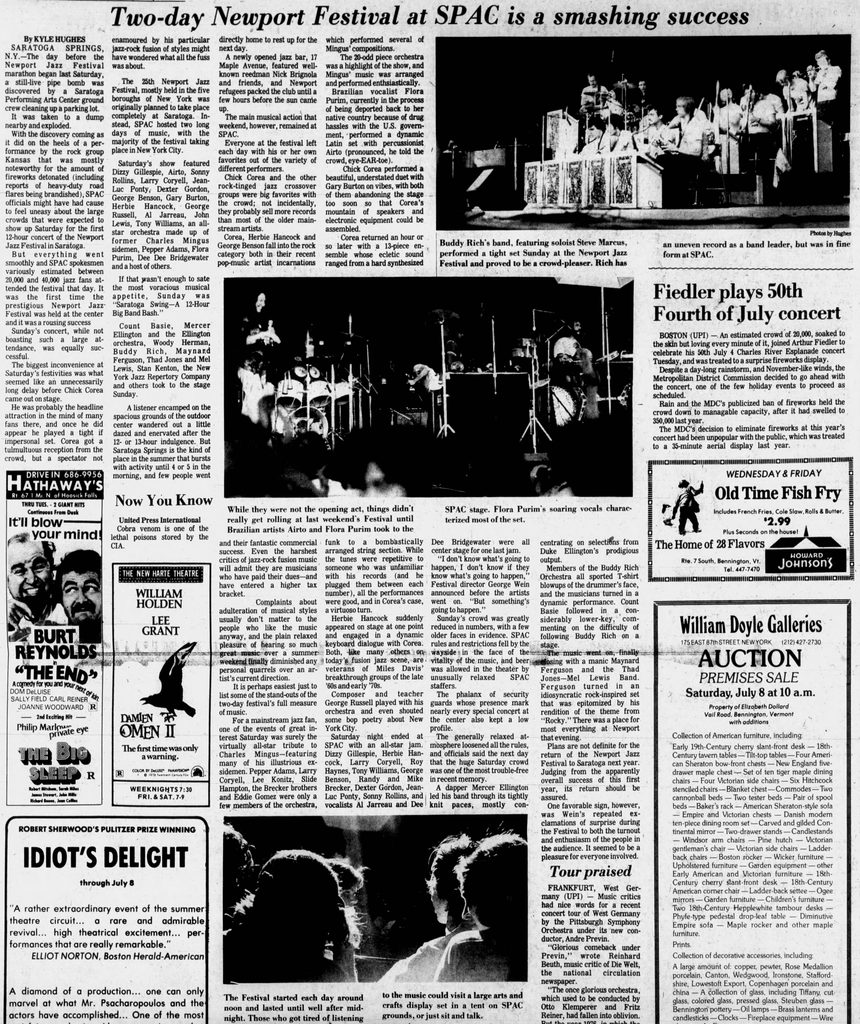
Members of the Buddy Rich Orchestra all sported T-shirt blowups of the drummer’s face, and the musicians turned in a dynamic performance. Count Basie followed in a considerably lower-key, commenting on the difficulty of following Buddy Rich on a stage.
The music went on, finally closing with a manic Maynard Ferguson and the Thad Jones-Mel Lewis Band. Ferguson turned in an idiosyncratic rock-inspired set that was epitomized by his rendition of the theme from “Rocky.” There was a place for most everything at Newport that evening.
Plans are not definite for the return of the Newport Jazz Festival to Saratoga next year. Judging from the apparently overall success of this first year, its return should be assured.
One favorable sign, however, was Wein’s repeated exclamations of surprise during the Festival to both the turnout and enthusiasm of the people in the audience. It seemed to be a pleasure for everyone involved.
Recent Comments