A two-day jazz festival brings Newport to Saratoga
by Stephen A. Monroe, Democrat and Chronicle, July 3, 1978
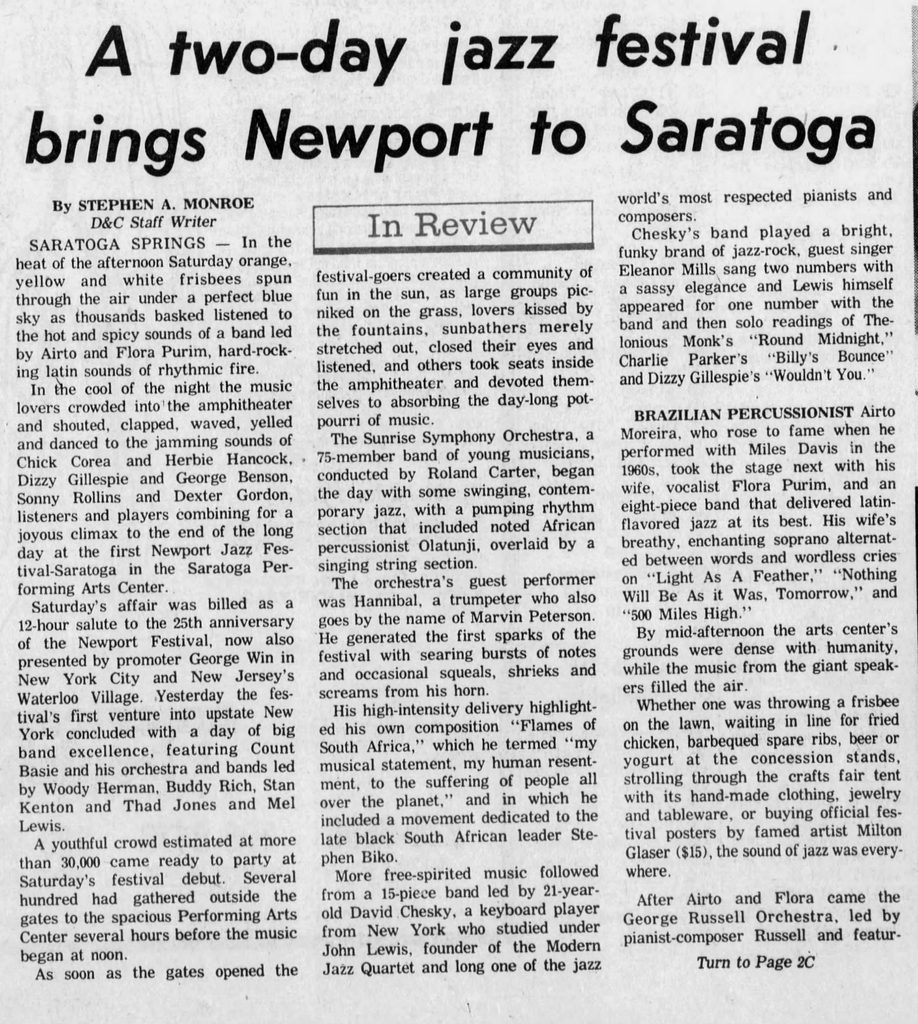
In the heat of the afternoon Saturday, orange, yellow and white frisbees spun through the air under a perfect blue sky as thousands basked and listened to the hot and spicy sounds of a band led by Airto and Flora Purim, hard-rocking Latin sounds of rhythmic fire.
In the cool of the night, the music lovers crowded into the amphitheater and shouted, clapped, waved, yelled and danced to the jamming sounds of Chick Corea and Herbie Hancock, Dizzy Gillespie and George Benson, Sonny Rollins and Dexter Gordon, listeners and players combining for a joyous climax to the end of the long day at the first Newport Jazz Festival-Saratoga in the Saratoga Performing Arts Center.
Saturday’s affair was billed as a 12-hour salute to the 25th anniversary of the Newport Festival, now also presented by promoter George Wein in New York City and New Jersey’s Waterloo Village. Yesterday, the festival’s first venture into upstate New York concluded with a day of big band excellence, featuring Count Basie and his orchestra and bands led by Woody Herman, Buddy Rich, Stan Kenton and Thad Jones and Mel Lewis.
A youthful crowd estimated at more than 30,000 came ready to party at Saturday’s festival debut. Several hundred had gathered outside the gates to the spacious Performing Arts Center several hours before the music began at noon.
As soon as the gates opened, the festival-goers created a community of fun in the sun, as large groups picnicked on the grass, lovers kissed by the fountains, sunbathers merely stretched out, closed their eyes and listened, and others took seats inside the amphitheater and devoted themselves to absorbing the day-long potpourri of music.
The Sunrise Symphony Orchestra, a 75-member band of young musicians, conducted by Roland Carter, began the day with some swinging, contemporary jazz, with a pumping rhythm section that included noted African percussionist Olatunji, overlaid by a singing string section.
The orchestra’s guest performer was Hannibal, a trumpeter who also goes by the name of Marvin Peterson. He generated the first sparks of the festival with searing bursts of notes and occasional squeals, shrieks, and screams from his horn.
His high-intensity delivery highlighted his own composition “Flames of South Africa,” which he termed “my musical statement, my human resentment, to the suffering of people all over the planet,” and in which he included a movement dedicated to the late black South African leader Stephen Biko.
More free-spirited music followed from a 15-piece band led by 21-year-old David Chesky, a keyboard player from New York who studied under John Lewis, founder of the Modern Jazz Quartet and long one of the jazz world’s most respected pianists and composers.
Chesky’s band played a bright, funky brand of jazz-rock; guest singer Eleanore Mills sang two numbers with a sassy elegance, and Lewis himself appeared for one number with the band and then solo readings of Thelonious Monk’s”Round Midnight,” Charlie Parker’s “Billy’s Bounce” and Dizzy Gillespie’s “Wouldn’t You.”
BRAZILIAN PERCUSSIONIST Airto Moreira, who rose to fame when he performed with Miles Davis in the 1960s, took the stage next with his wife, vocalist Flora Purim, and an eight-piece band that delivered Latin-flavored jazz at its best. His wife’s breathy, enchanting soprano alternated between words and wordless cries on “Light As A Feather,” “Nothing Will Be As It Was, Tomorrow,” and “500 Miles High.”
By mid-afternoon, the arts center’s grounds were dense with humanity, while the music from the giant speakers filled the air.
Whether one was throwing a frisbee on the lawn, waiting in line for fried chicken, barbequed spare ribs, beer or yogurt at the concession stands, strolling through the crafts fair tent with its hand-made clothing, jewelry and tableware, or buying official festival posters by famed artist Milton Glaser ($15), the sound of jazz was everywhere.
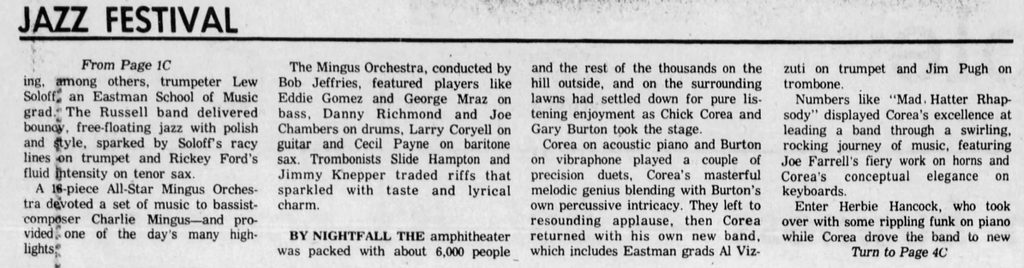
After Airto and Flora came the George Russell Orchestra, led by pianist-composer Russell and featuring, among others, trumpeter Lew Soloff, an Eastman School of Music grad. The Russell band delivered bouncy, free-floating jazz with polish and style, sparked by Soloff’s racy lines on trumpet and Ricky Ford’s fluid intensity on tenor sax.
A 16-piece All-Star Mingus Orchestra devoted a set of music to bassist-composer Charlie Mingus and provided one of the day’s many highlights.
The Mingus Orchestra, conducted by Bob Jeffries, featured players like Eddie Gomez and George Mraz on bass, Dannie Richmond and Joe Chambers on drums, Larry Coryell on guitar and Cecil Payne on baritone sax. Trombonists Slide Hampton and Jimmy Knepper traded riffs that sparkled with taste and lyrical charm.
BY NIGHTFALL, the amphitheater was packed with about 6,000 people and the rest of the thousands on the hill outside and on the surrounding lawns had settled down for pure listening enjoyment as Chick Corea and Gary Burton took the stage.
Corea on acoustic piano and Burton on vibraphone played a couple of precision duets, Corea’s masterful melodic genius blending with Burton’s own percussive intricacy. They left to resounding applause, then Corea returned with his own new band, which includes Eastman grads Al Vizzuti on trumpet and Jim Pugh on trombone.
Numbers like “Mad Hatter Rhapsody” displayed Corea’s excellence at leading a band through a swirling, rocking journey of music, featuring Joe Farrell’s fiery work on horns and Corea’s conceptual elegance on keyboards.
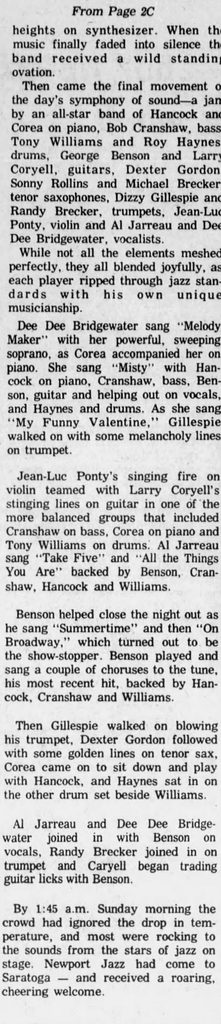
Enter Herbie Hancock, who took over with some rippling funk on piano while Corea drove the band to new heights on synthesizer. When the music finally faded into silence, the band received a wild standing ovation.
Then came the final movement of the day’s symphony of sound—a jam by an all-star band of Hancock and Corea on piano, Bob Cranshaw, bass, Tony Williams and Roy Haynes, drums, George Benson and Larry Coryell, guitars, Dexter Gordon, Sonny Rollins and Michael Brecker, tenor saxophones, Dizzy Gillespie and Randy Brecker, trumpets, Jean-Luc Ponty, violin and Al Jarreau and Dee Dee Bridgewater, vocalists.
While not all the elements meshed perfectly, they all blended joyfully, as each player ripped through jazz standards with his own unique musicianship.
Dee Dee Bridgewater sang “Melody Maker” with her powerful, sweeping soprano, as Corea accompanied her on piano. She sang “Misty” with Hancock on piano, Cranshaw, bass, Benson, guitar and helping out on vocals, and Haynes on drums. As she sang “My Funny Valentine,” Gillespie walked on with some melancholy lines on trumpet.
Jean-Luc Ponty’s singing fire on violin teamed with Larry Coryell’s stinging lines on guitar in one of the more balanced groups that included Cranshaw on bass, Corea on piano and Tony Williams on drums. Al Jarreau sang “Take Five” and “All the Things You Are” backed by Benson, Cranshaw, Hancock and Williams.
Benson helped close the night out as he sang “Summertime” and then “On Broadway,” which turned out to be the show-stopper. Benson played and sang a couple of choruses to the tune, his most recent hit, backed by Hancock, Cranshaw and Williams.
Then Gillespie walked on blowing his trumpet, Dexter Gordon followed with some golden lines on tenor sax, Corea came on to sit down and play with Hancock, and Haynes sat in on the other drum set beside Williams.
Al Jarreau and Dee Dee Bridgewater joined in with Benson on vocals, Randy Brecker joined in on trumpet, and Coryell began trading guitar licks with Benson.
By 1:45 a.m. Sunday morning the crowd had ignored the drop in temperature, and most were rocking to the sounds from the stars of jazz on stage. Newport Jazz had come to Saratoga – and received a roaring, cheering welcome.
Recent Comments