Newport Festival Plays Its Jazziest at Season Finale
by Cliff Smith, Rochester Times-Union, July 3, 1978
The Newport Jazz Festival, honored on its silver anniversary two weeks ago with a concert on the White House lawn, closed out this weekend on the greens of the Saratoga Performing Arts Center.
The fresh-air settings were appropriate. America’s longest-running jazz festival started in the summer of 1954 on the grass tennis courts of the Newport Casino in Newport, R.I.
It was the festival’s first visit to this upstate New York resort town. But the crowds led producer George Wein to predict that the festival may have found a new home.
He estimated 25,000 people attended the 13½ hour concert Saturday and 15,000 attended the 12-hour concert yesterday.
Although jazz used to be confined to crowded, smoky clubs, music of improvisation and freedom seems to thrive outdoors. Saratoga certainly provided more ambience than have the sterile concert halls of New York City, where most of the festival has taken place for the last eight years.
The music this weekend was consistently exciting, and the audience was appreciative. A friendly crowd of predominantly young people Saturday filled up the 5,100 seats in the amphitheater. They spread over the hillside and plateau behind those seats, packed onto lawn chairs, blankets, sleeping bags, and towels. They had picnics, tossed frisbies and played backgammon. They waited in long lines at the refreshment stands and restrooms.
But most of the time they enjoyed the sunshine and vibrations from the music. They saved their longest and loudest applause for new faces such as David Chesky and Egenesis and for favorites like Flora Purim and Chick Corea, during Saturday’s “Jazz Today and Tomorrow.”
Chesky, 21, is a former student of pianist/composer John Lewis of Modern Jazz Quartet fame. Chesky played the keyboards standing up and leaped all over the stage, directing his 15-man orchestra like a college cheerleader. That orchestra responded to the enthusiasm of its skinny conductor with some of the most rousing fusion of jazz, rock and rhythm-and-blues at the festival. Chesky, who wrote all the arrangements, brought on Lewis, his old teacher, to perform Lewis’ La Ronde” in a new orchestration.
Egenesis, a shaven-headed singer, turned on the heat with a scat-singing version of “New York, New York” and a tender interpretation of Billie Holiday’s “God Bless the Child.”
Brazilian singer Flora Purim appeared with the smallest group on the program, a sextet led by her percussionist husband Airto. She performed with a microphone in each hand, which probably helped her sound twice as loud as she needed to. But the audience cheered lustily for her hits, including ‘Free,” “In Brazil,” and “500 Miles High.”
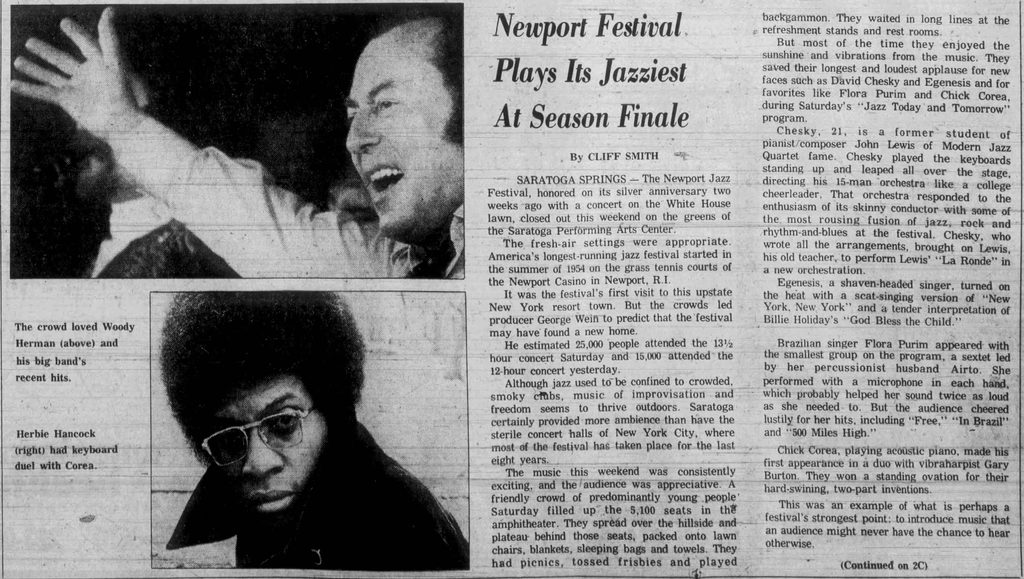
Chick Corea, playing acoustic piano, made his first appearance in a duo with vibraharpist Gary Burton. They won a standing ovation for their hard-swinging, two-part inventions.
This was an example of what is perhaps a festival’s strongest point: to introduce music that an audience might never have the chance to hear otherwise.
Corea’s 13-person band brought more roars of approval from the crowd with a reprise of hits such as “Night Strike,” “Day Dance,” “Mad Hatter Rhapsody,” “Soft and Gentle” and “Spanish Fantasy.” The band includes trumpeter Allan Vizzutti and trombonist Jim Pugh, both Eastman School of Music graduates.
Pianist Herbie Hancock brought shouts of recognition as he bounded on stage during the middle of “Mad Hatter.” He dueled with Corea on the electric piano. He reappeared with an all-star group, which closed the concert at 1:30 a.m. yesterday. The playing of George Benson, Dizzy Gillespie, Dexter Gordon, Sonny Rollins, Jean-Luc Ponty, Larry Coryell, Mike and Randy Brecker, Tony Williams and Bob was appreciated. But it was a trio of singers – Al Jarreau, Dee Dee Bridgewater and Benson, who had laid down his guitar – that brought the audience to its feet with a witty version of “Misty.”
Yesterday’s smaller and predominantly middle-aged crowd spent the afternoon and evening with nine big bands. The swingingest one of all, the New York Jazz Repertory Company Orchestra, led by pianist/arranger Dick Hyman, forgot its music and had to fake its playing during three appearances.
But it did a wonderful job, out-Basieing the Count Basie band with its relaxed sax-section riffing behind soloists. It featured a disciplined but free-flowing rhythm section which, like Basie’s, was enhanced by an acoustic guitar. Woody Herman brought “Four Brothers” and “Early Autumn” back from the 1940s, but it was his most recent music that was received most warmly. The high point came during “Pavanne,” from his new “Road Father” album. It featured gorgeous low- and middle-register clarinet by Herman, Frank Tiberi’s bassoon playing, and Gary Simonia’s
baritone sax.
The Duke Ellington Orchestra, directed by his son, Mercer, was best on such neglected Ellington pieces as “Ko Ko,” “The Star-Crossed Lovers” and “Three Black Kings.”
Kenton, barely able to walk unassisted on stage, played piano well enough on “Body and Soúl,” “All the Things You Are,” “Chelsea Bridge,” and “Send in the Clowns.”
Trumpeter Harry James stayed out of range of the high notes and kept to crowd-pleasers from the 1940s such as “Back Beat Boogie,” “Don’t Be That Way,” “You’ll Never Know,” “I’m Beginning to See the Light” and “Don’t Get Around Much Anymore.”
Recent Comments